
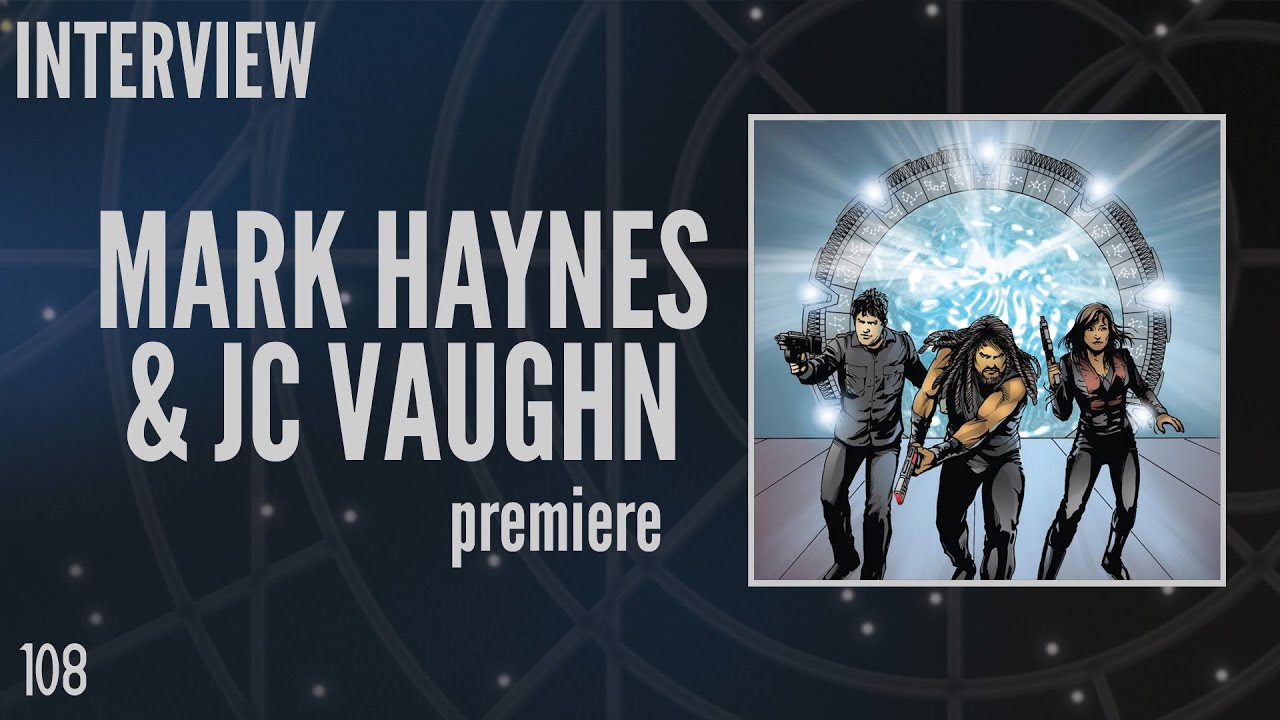
Mark L Haynes & JC Vaughn, Stargate Comics
Description
At the conclusion of Stargate Atlantis and Stargate Universe, we were all a bit more empty inside. With the merchandising opportunities for Stargate, that void was filled slightly by the comics of Mark L Haynes and JC Vaughn! They join us to discuss their creative process for the franchise and take your questions LIVE!
Share This Video ► https://youtu.be/sfLBA9MXJZY (opens in a new tab)
Mark Haynes on Twitter ► https://twitter.com/MarkHaynes (opens in a new tab)
JC Vaughn on Twitter ► https://twitter.com/jcvaughn1 (opens in a new tab)
Mark Haynes' Web site ► https://www.markhaynesproductions.com/ (opens in a new tab)
MyComicShop.com ► https://www.mycomicshop.com/ (opens in a new tab)
AmericanMythology ► https://www.americanmythology.net/ (opens in a new tab)
Visit DialtheGate ► http://www.dialthegate.com (opens in a new tab)
on Facebook ► https://www.facebook.com/dialthegate (opens in a new tab)
on Instagram ► https://instagram.com/dialthegateshow (opens in a new tab)
on Twitter ► https://twitter.com/dial_the_gate (opens in a new tab)
MERCHANDISE!
https://dialthegate.myspreadshop.com/ (opens in a new tab)
SUBSCRIBE!
https://youtube.com/dialthegate/ (opens in a new tab)
Timecodes
Chapters
Transcript 17,555 words · Archived by Susan Gardiner
David Read: Hello, everyone, and welcome to episode 108 of Dial the Gate. That rhymes. My name is David Read. Thanks so much for joining me. We have JC Vaughn, Jeff Vaughn, and Mark Haynes waiting in the wings here. Stargate Atlantis and Universe comics writers. We’re going to have them on for this episode, so if you have read the comics, or you haven’t read the comics and have some questions for them, this would be the time to ask. For this episode, let me pull this up here, if you like Stargate and you want to see more content like this on YouTube, it would mean a great deal if you click that Like button. It makes a difference with YouTube’s algorithm and will help the show grow its audience. Please also consider sharing this video with a Stargate friend. And if you want to get notified about future episodes, click the Subscribe icon. Giving the Bell icon a click will notify you the moment a new video drops, and you’ll get my notifications of any last-minute guest changes. And clips from this live-stream will be released over the course of the next few weeks on the Dial the Gate and GateWorld.net YouTube channels. As this is a live show I will be asking our guests questions and giving you an opportunity in the live chat at YouTube.com/DialtheGate to submit questions. Our moderators are standing by waiting to take your questions down and submit them over to me. Antony and Tracy are both there now. Without further ado, let me bring in my guests for this hour. Mr. Mark Hynes. Is it Hynes or Haynes?
Mark L. Haynes: Haynes, please.
David Read: Mark Haynes. And Jeff Vaughn, JC Vaughn, Stargate Atantis and Unvierse comics. These were released through American Mythology, is that right?
David Read: Well, welcome to the show! Thank you so much for joining me!
Mark L. Haynes: Yes.
Mark L. Haynes: Well thanks for having us!
David Read: Thank you! Mark can you first give me a bit of background about you and then Jeff, please?
JC Vaughn: Yeah, um, I started writing comics. Jeff and I actually worked together at a magazine in the late 90s, called Overstreet’s Fan, it was a competitor to a magazine called Wizard. And even before I met Jeff, I was an art director on that magazine, assistant art director and I happen to lay out a story that he wrote about Superman vs. Aliens, which was the big DC event that was happening at that time. And we became friends and then just as our kind of work alongside kind of in the periphery of the comic book business, we started writing different things together and we were invited to pitch to Star Trek Enterprise, I’m sorry, Star Trek Voyager. Yeah. And then I went along on to pitch to Enterprise
Mark L. Haynes: And that’s really kind of what got us into the writing thing. We were roommates for a little while when we both lived in the Baltimore area. And then I think what really got us started in doing this in a serious way was Jeff was a big fan of the TV series 24 with Kiefer Sutherland it was on Fox in the early 2000s. And then, I thought it was a gimmick. I was like, “Oh, this sucks. I’m not interested.” Oh, pardon. Oh, we got to watch a watch my language fine. I just didn’t think it was gonna catch on. And then at one point, he was out of town, but he bought the DVDs. So I I binge them through the weekend and was hooked. Coincidentally the two biggest successes we had writing comics, which were, for me, anyway, was 24 and Stargate, as we were writing them together are both things that I was not interested in before he asked about. Yeah, I mean, I’d seen the movie with Kurt Russell and James Spader and I was like, “Oh, this is great.” And then the TV show started. I didn’t and couldn’t afford Showtime when it came on. So I convinced myself I was not interested. And then at one point, I think he was somewhere and he saw it. He’s like, “You should really check this out because it’s kind of funny and but it’s there’s like this serious undertone to the story.” And again, it was one of those things that I checked out on a free preview week or whatever, right?
David Read: That’s right, the Showtime the free week.
Mark L. Haynes: So that the rest is they say is history I mean, I look back on my writing career and I think almost better than half to three quarters of the writing opportunities I’ve gotten on cool things like Stargate and 24 have come through Jeff. So that’s how I got here.
David Read: Jeff any blanks you want to fill in?
JC Vaughn: Yeah, I never think of it that way. As Mark is creative on so many fronts. He’s a highly, this is gonna sound condescending I don’t mean it that way, he’s a highly competent designer. I mean, he on a whim can do stuff that takes people weeks to put together. And it’s always really cool to see the way his brain works on something and tries to perfect it and he does it so much faster than most people. Mark’s right in how we met. I had been freelancing for Overstreet publications. And Bob Overstreet sold his company to Steve Geppi, it became part of Gemstone Publishing, and they were created…
Mark L. Haynes: For people who don’t know Bob Overstreet created the Overstreet Comic Book Price Guide, which is kind of the Bible for aftermarket comics.
David Read: Okay, so yeah, I know what that is. And I Yeah, yeah. Kelley Blue Book for comics.
Mark L. Haynes: Yes, exactly.
JC Vaughn: Very good fill in the blank there Mark. Bob created the price guide in 1970. And while he is still in his 80s he’s still doing it. And this is a guy and who, talk about the power of being a fan, just to diverge for just a second here. Bob was a fan of the EC Comics: Tales from the Cryp, Weird Science, all those things like that. Somebody would have done a price guide for comics. Every niche has one if it lasts.
JC Vaughn: Yeah, right. But Bob was a coin enthusiast and so he used the logic of that, and put together comics, but it wouldn’t have been a Bob Overstreet without the EC Comics. So that’s the power of being a fan playing out now across, we’re working on the 52nd edition of it right now. And so I freelanced for Bob at his old company, he sold it to Steve Geppi, who owns Diamond Comic Distributors for Gemstone Publishing. And Mark was the Assistant Art Director and I sold my first cover story, which was for the first issue of this new magazine. And it was as Mark said, Superman versus Aliens, this great EC Comics, Dark Horse Comics crossover. And I was psyched because it was my first cover story. And I was still freelancing. And then I found out that not all of the people moved with Bob’s company to Maryland, and they had some openings. And I went up for the interview. And I called my better half, we were in a long distance relationship at that point, I lived in Texas. And this was in Baltimore and she’s in New York. I called her that morning, and I said, “Hey, am I taking this job?” And she says, “It’s only eight o’clock you haven’t had your interview yet.” I said, “I’m getting this job whether I take it or not.” And I met Mark that day. I think within two days he goes, “You don’t freak out a lot do you?” And I think we were really good friends from that moment on.
David Read: A matter of time.
Mark L. Haynes: And we were both working with people who freaked out a lot [inaudible]
JC Vaughn: Some of whom measured your enthusiasm by how much you freaked out, which is exact opposite of both of us were problems. And we really, there’s a lot of things we had in common, we’re both big Star Trek fans and open to new sci fi and just all a lot of pop culture stuff that was really good bonding material. And then we got into the opportunities to do some stuff. And one of the great things is that Mark is a really detail oriented guy. And we ended up acquiring, Mark really did, but we ended up acquiring a company that was publishing Battlestar Galactica comics, and …
David Read: Not your original Galactica, right?
JC Vaughn: Yeah. Yes, thank you. Yes, classic. But we both loved it. I’m still hung up the fact that they on the East Coast they interrupted the pilot for the Camp David peace accords. I still haven’t gotten over that. But Mark would spend like this serious amount of time making the sound effects pronounce right. [inaudible]
Mark L. Haynes: That’s how much of a nerds we are.
JC Vaughn: I mean, that level of care. He’s always our continuity cop. I’ll throw out ideas and it’s not that I don’t remember that kind of stuff, it’s just I’m lazy because I know he’s got it. Jim Kuhoric, who was our publisher at American Mythology, was the writer, I was the editor, and Mark was the publisher, producer, letterer, designer, everything else that needed to be done. And we really found good ways of working together on that, though because we were working with a bunch of other freelancers, there was no one set way that we worked on it, which is sort of ended up being our approach to many scripts. There’ll be scripts that the idea is totally 50/50, or even more Mark, but I’ve ended up writing the script, that happened on one issue at 24. There’s been stuff where we just go back and forth, back and forth, changing it a lot. And I’ll write a pass, he’ll write a pass, we’ll be on the phone and do it together. And so this actually bled over to when we got the opportunity to do Stargate. I live in New York and Mark was in Los Angeles. I would, generally speaking, go out the week before San Diego Comic Con, and crash with him. And we would just plot like crazy. And we do like a year’s worth of plot, right then. And occasionally we’d have stuff that Jim would want us to get in there. And we’d have to work around, either make it work, or say, “You’re out of your mind.” That kind of stuff. But that’s how we got started.
Mark L. Haynes: Or we would say, “You’re out of your mind” and then we would make it work anyway.
JC Vaughn: More likely, that’s the case. But we got to, as Mark said, we got to the Stargate where I had checked out the original TV series, and sort of found a soft spot for it. And the further it went, the more I liked it. I wasn’t totally in love with it at first with the one exception of well, of course if the Gate could dial one place, it could dial a gazillion different places. Which when I was watching the original movie, it never occurred to me. I have to admit that.
David Read: That was a combination lock. Locks one place. Yeah,
JC Vaughn: Yeah. That’s how I took it.
David Read: Yeah. And then this thing just explodes.
JC Vaughn: Yeah.
David Read: Mark go ahead.
Mark L. Haynes: Well, and then to kind of dovetail with what Jeff said, in terms of what he said, in terms of how it grows on you, is that unlike a lot of other sci fi franchises that I think are set in the future, like Star Trek or long time ago in a galaxy far, far away is we’re aware of these are contemporary people. So it’s like there were serious concerns that they were dealing with, but it’s like mixed with a workplace comedy, in some ways. And so it was just like, what’s your reaction to certain things and specifically what the character of O’Neill is, everybody looks at Richard Dean Anderson and says, “He was born for this part.” Like he took this part and turned it into something incredible because of the way they dealt with the death of O’Neill’s son in the show. And it drove everything, his smartass attitude, is bucking of authority. He would never, he would push it to the line. But his irreverent take on things was masking that pain that he carried the entire time.
David Read: I think that’s why the character works.
Mark L. Haynes: But yeah, exactly.
David Read: We would look at this guy and go, You know what, this dude is just a smart ass. Yeah, if we didn’t have the genesis of that character at the beginning, it’s like, okay, this guy has transcended the worst pain a parent can ever have. And you know what, everyone around him just puts up with it. What else are you going to do? He’s perfectly competent at his job and excels at it. Despite all of his personal tragedy, his life as a tragic comedy.
JC Vaughn: There’s a step further. There’s a step further with it you guys are both touching on. And that’s this. There’s always this thing of shows around whether it’s set in the past, the present or the future, we need you back. And we’re supposed to believe that Starfleet needs one guy out of an entire galaxy of people back or fill in the blank. They knew this. But Jack, having been the only CO to go through a Stargate. They really did have jobs and that was true that explodes that cliche and he was the guy they needed back
David Read: It’s the call to adventure.
Mark L. Haynes: Yeah, yeah, exactly. And then I think what really brought it, I hesitate to use the word full circle at a Stargate program because you know, anyway, it’s been done to death and we’re gonna keep doing it. But one of our favorite episodes that Jeff and I, we each have our favorites out of all the series, but one that you can just keep going back to is Window of Opportunity,
David Read: Of course.
Mark L. Haynes: And you know, and it’s like, it’s this really bizarre comedy for the first three quarters of the episode. And then when you finally get to what’s happening, and he’s like, “I lost my son” and you’re just like, boom, it’s there all the time. You know? And so it’s like, that’s when it really kind of hit me. It’s like, okay, this show is something and what’s funny is that, we wrote Stargate Atlantis and Stargate Universe for comics, because our publisher was not able to get SG-1 at that point. All through while we were doing it and even to this day, I think he’s still attempting to negotiate. And I don’t know how the Amazon MGM deal has affected that but he’s attempting to negotiate some type of master agreement that would let us use those characters in that environment. Because one of the things that and I may be jumping around a little bit, but what we were able to do with Atlantis was the directive we received from MGM was you can use any characters that appeared on Atlantis, on the TV show Atlantis, in the comic book. And it’s like, well, that’s almost everybody from from SG-1. With the exception of Richard Dean Anderson, because he controls his own likeness…
David Read: He has his own rights. I noticed reviewing the content that there was a scene at Homeworld Command that it’s pretty evident that it’s Jack, but the Homeworld Command coffee mug is doing the talking.
Mark L. Haynes: Yes.
JC Vaughn: We had been told that they would go to Richard for his approval but they weren’t going to do it for small scenes. Well, all we needed was small scenes.
Mark L. Haynes: That was his contribution to Atlantis was generally just small scenes. Other than the two part where he and Woolsey are trapped on the city, which is hysterical. I love that part. Anyway, go ahead Jeff.
JC Vaughn: And some of the interesting things that we encountered on our journey were things that had been described as other than what they were to us ahead of time.
David Read: Explain that, if you can.
JC Vaughn: MGM would have a set of rules. And we would abide by those rules and then we would be told that the rules had changed. Sometimes we would be notified this after things were approved. So there would be things that were drawn, and we would have to fix in lettering, and just make up some oblique comment.
Mark L. Haynes: Well, it would be outline approved, script approved, pencils approved, pencils get inked, disapproved. No rhyme or reason to it in any particular way. It was hard to follow and was really hard to fathom. Because for a large portion of our writing careers, we’ve both had day jobs that we pursue, and in various capacities at different size businesses. And so we’re always thinking like, what is the business reasoning behind your position and they didn’t really want to come clean or really share that because in a lot of instances it had they shared that we might have been disappointed, but we wouldn’t have been po’d. We really wouldn’t have been terribly upset about it. We would have figured out a way around it. But I don’t know Jeff, if you want to share one of our best ones which was you know, Camile and Shen.
JC Vaughn: We had [inaudibel]
David Read: Yeah, Camile Wray and Shen, because I was going through one of them and I was like, “Oh, look at Shen Xiaoyi,” but I wasn’t entirely sure at first because on the penciling of them, they look very similar because it’s very abstract. Could it be Camile? And I was wondering if that was Camile in Atlantis and then I saw Woolsey write Shen. So please continue, [inaudible]
JC Vaughn: We knew that this was a concern, characters appearing on the show…
Mark L. Haynes: On different parts of the franchise.
JC Vaughn: On one show on another, and we came up with the idea that Camile might have been Shen’s protege.
Mark L. Haynes: They’re both women, both women of color, working in the federal government at the Department of Defense. It made sense that they might have found each other.
David Read: And it’s not that big in some of those department. Some of those departments not that large, pretty much everyone knows everybody.
JC Vaughn: And yeah, you know, the IOC is a pretty…
Mark L. Haynes: IOA
JC Vaughn: Always a tight community.
Mark L. Haynes: IOC does the Olympics.
JC Vaughn: Yes, thank you. I think that it was logical and there was a bit of fun for us because we’re writing both books. And we wanted to add in character backstory that nobody had thought of, and to this day I think it was a great thing. So we knew that this was touchy. So we went to them and said, “This is what we would like to do.” This is before we even wrote the script.
David Read: For Atlantis?
JC Vaughn: Yeah.
Mark L. Haynes: Was it Atlantis or Universe book.
JC Vaughn: Atlantis.
Mark L. Haynes: Okay.
David Read: Yeah, cuz because Camile is in the Universe book.
JC Vaughn: Yeah. Camile is in the Universe book. So we’re having her communicating was Shen. And we got the approval. And then we did it. And then we got unapproved. And you know…
Mark L. Haynes: Yeah, the biggest motivation behind doing this is I had a writing mentor tell me one time that if you’re a staff writer working on a TV show, and I think we touched on this when we were chatting at San Diego last weekend, San Diego Comic Con Special Edition, was that if you’re a writer in the room, your job is to support the vision of the showrunner. You’re to write episodes that the characters are and situations totally match what they have in mind. You bring your own unique perspective to it as a writer, but ultimately, it’s supposed to fit within the context of the show created by another person.
David Read: You’re servicing that idea.
Mark L. Haynes: Exactly, exactly. And what Jeff and I always did whenever we were writing these license comics, we would kind of take that on as our mindset when we were doing it so that as a result, I mean, our comics, in a lot of cases, may not have been huge selling comic books, but in their categories, they did quite well. And the reviews were always like, “I can hear the characters speaking it sounds like in my head, and it feels like an episode of the show.” And so what we wanted to do was as closely as possible in comic books, replicate the experience of watching an episode of Stargate Atlantis or Stargate Universe. And that meant these characters all inhabit the same fictional universe together. So on the one side, you have, they all inhabit the same fictional universe together. On the other side, you have three different shows with multiple different deals with different actors and studios and liabilities, and all these other kinds of things. So we understood the business reason and looking back you can only imagine like, what were the legalities involved in having a different character from another show appear. One from SG-1 on Atlantis and Atlantis on SGU and vice versa. And it’s like, it seems like it was a lot easier for them to do it than it was for us.
David Read: Well, I know for Atlantis, in terms of control of, I’m missing the legal term for it, what Rick had in terms of for SG-1.
Mark L. Haynes: Likeness rights?
David Read: Right. For instance, and all of the things that have to do with that there wasn’t for Atlantis, were then returned to the actors for Universe like all of them had that. So I wonder if that’s something where Ming Na who didn’t have a footing in Atlantis, did in Universe with Camile Wray, and then something came about where they had to pull a lever or they realized that they did not communicate with her.
JC Vaughn: I can strangely enough answer that question. Lou Diamond Phillips and Ming were the only people who didn’t have likeness rights.
David Read: Really?
JC Vaughn: Oh, yeah. And we got that from MGM.
Mark L. Haynes: Oddly that was the case. And what’s interesting is that this goes back to even, we tend to pick up shows that have these situations. Like when we were doing the Battlestar Galactica comics based in the 1979 version, you think back and you’re like, “Well, this was kind of a Star Wars analog for television.”
David Read: It’s exactly what it was designed from. Yeah,
Mark L. Haynes: Yeah, exactly. And Star Wars had that boatload of toys, and you think, “Oh, my gosh, there’s going to be this huge boatload of Battlestar Galactica toys coming.” and you get some spaceships, you get some aliens, you get a Cylon figure and then you get commander Adama and Starbuck. Apollo is nowhere to be seen, Boomer is nowhere to be seen. And it turns out that Lorne Greene and Dirk Benedict, their likeness rights come with the license to the show. Richard Hatch’s did not. So we were only able to meet him later at a convention and say, “Can you write us a letter that says we can use your likeness rights?” And he’s like, “Can I write an issue with the comic?” And we agreed, but then he didn’t end up [inaudible] sequenced before we had to let the license go. Because yeah, one of the things that and it was gonna be a riff on his novel. So it was not like a huge kind of new thing. But we like to look at that and the idea of the comic book kind of gave him a little bit of fuel. That because he was trying to get a new production launch there in the early 90s, or late 90s, early 2000s. And we feel like that that’s kind of what brought enough heat to it to get somebody like Ron Moore [inaudible]
David Read: Exactly, right. Yeah. Richard Hatch was always had, he always had a love for that property. And he revered Ron Moore’s version, he would get teary eyed when discussing it because it was such a big deal to him. What an arc that character had over the course [inaudible]
Mark L. Haynes: Yeah. There was there was some stuff I mean, I love them both actually. And I think they can coexist. But it would always be fun to go back and see what we would have done had Galactica arrived on Earth. We had plots for stories that we never got to do, one of which was a Battlestar built by, we get to see this eventually in Stargate, the idea of a Battlestar built by Earth.
David Read: Built by modern humans. Yeah.
Mark L. Haynes: Yeah, exactly. And you got Vipers with US Air Force markings or whatever country have built them because at that point, the Cylon threat is going to force the countries of Earth to work together to defend the planet, right? And then of course, flash forward to to Stargate SG-1 and Atlantis, and then you get giant Earth built starships utilizing alien technology.
David Read: I think but it is my hope that the next Stargate, if it continues continuity with Wright and Cooper and those guys, our technology has advanced to the point where you have to ask yourself, “What do we do next?” And I think the thing that we do next is that we make our own Stargates. Like I would love to see a US Air Force built Stargate.
Mark L. Haynes: Yeah, absolutely.
David Read: And just use using the same points in space, but…
JC Vaughn: It only works with a Verizon system.
David Read: Is it running 5g?
Mark L. Haynes: Yeah, you didn’t pay the cable bill. What are you talking about?
David Read: Have Verizon manufacture it. Have them be like a sponsor on the show.
Mark L. Haynes: Well, they were going I mean, they were definitely going in that direction.
David Read: With Dell?
Mark L. Haynes: Yeah. Some of the Atlantis storylines with the nanites and stuff like that with the…
JC Vaughn: Stargate only works with your Fitbit.
Mark L. Haynes: Oh man, Apple watch. No, no, I’m just kidding. I have an Apple Watch. So I’m not slamming Apple at all.
David Read: Let’s go to Atlantis, season six, the back to Pegasus arc that you guys did. What were you wanting to do with that? What did you achieve? What did you not get a chance to do? Jeff if you could start us off.
JC Vaughn: Yeah, sure. I’ll start with that in backwards order, the stuff that we didn’t get to do was more issues than we did. The approval process was really slow. Some of the artists before Gordon Purcell were, they were put through a lot of changes. And some of them understandably, some of them not. And that really slowed down the process. Gordon is a super professional guy used to working with licensed titles, of course, a vast experience with Star Trek. And he really delivered not only what we put on the paper, but on a timely basis. So the ability to do more, and I also found, quite frankly, that the turnaround time on the approvals was abysmal. That said, what we got to do. First thing, Atlantis being on Earth is just like it’s just a dumb, dumb, dumb thing if you’re gonna leave it there, in terms of then it’s just SG-1. Now if you’re just leaving from Earth and going and doing things and you’ve got this secret floating thing that you don’t want people to discover. That’s your novelty. The adventure is out there in Pegasus, there’s just too much in Atlantis that’s wonderful, and needed to be redone. So we got that pretty quickly. And Mark had come up with a year. I mean, I don’t know, Mark, years, before we ever did the comic, come up with a concept that we were able to drop into this. Which was a Gate Hub.
Mark L. Haynes: Oh, yeah, I’ll just say when Jeff was referring to approvals, primarily it was MGM studio approved, consumer licensing approvals, which were just it was very hard to predict. And to just clarify a little bit for the artists that we had early on in the run of the book, constantly going back to an artist with those types of changes, even when they’re drawing for an approved script, without stepping out of the license comic thing for a while, because nobody’s making an incredible amount of money, you got to get the fulfillment of a project comes from seeing a creative vision come to life. And so when we’re writing, we write specifically in certain instances to make sure it gets approved. But the artist is generally free to bring whatever they want. They’re kind of the director of photography, if we’re the writers, producers in that type of [inaudible]
Mark L. Haynes: Exactly. And so when they get a lot of, no this has to be this way, this has to be this way, they’re going back and doing a lot of changes. The meter is running for the publisher, who’s already on a thin margin. So it was hard to keep an artist for the run of the book, which is always important, when you go to collect it, you’re flipping through it. And when the art style changes as drastically as it did through the course of the book it can be disconcerting to a reader as well as ourselves. And in some cases, what we were dealing with early on in the book was artists who would not draw things that, granted they have the freedom to do what they want in a lot of cases. But in some cases where we specify something, it’s a plot point that didn’t get drawn, it’s sometimes there’s spots where it’s not going to make sense. So that was a little bit of the frustration early on in terms of saying something that we got to do that we didn’t want to do. Let’s just flip the question a little bit. But one of the things that we did get to do was this idea of multiple gates systems, it’s kind of like a version of the Intergalactic Gate Bridge. And what we did was think that at some point, the Ancients that develop the Stargate would have had an easier way to get from system to system, go from one gate system to the other. So we kind of came up with this idea that somewhere lurking out in our Milky Way galaxy, or even at some point between galaxies, there is a version of the Intergalactic Gate Bridge that Rodney and Carter developed. But connects instead of just two gate systems, up to six gate systems. So the idea was that basically what we’re trying to do is find ways to open up the story a little bit.
David Read: Correct, they’re lights and yeah, do…
David Read: Other galaxies.
Mark L. Haynes: Yeah, exactly. other galaxies. And also like a parallel system within our galaxy that may go to different planets than the main system does.
JC Vaughn: Basically a local system. If your regular Stargate is the express, here’s one that goes from this station to another gate that’s near Earth that we didn’t know about before.
Mark L. Haynes: The idea was that the gate system, because they always use the analogy of telephone, telephone analogy. That this would be like an extension in an office phone system. So it’s like I want to go from this planet in the same star system to another moon or another planet in the same system. And I don’t have a ship, ships are expensive to run, whether you the Ancients developed them or not, there’s still a cost to it. Time factor. Yeah. So why wouldn’t you develop a short range Stargate that would let you get to the moon and back instantly, and so we just were trying to play with different takes on the technology and see what we could come up with. And again, all for the purpose of going beyond these stories that each kind of had a specific purpose. Which primarily for the first one was to get Pegasus off Earth and back to, or get Atlantis off Earth and back to the Pegasus Galaxy.
David Read: OK. And this wasn’t fully, so did you hint at this in the earlier comics that are out?
Mark L. Haynes: Yeah, yeah. Basically the way we had visualized it in the script was if you think of an airport terminal with gates going down both sides, doors to the planes. It’s just sort of been Stargates going down sides. And it was drawn quite a bit differently than we had anticipated.
David Read: Oh, I understand.
Mark L. Haynes: The full effect is not there.
David Read: Yeah, that’s the thing, I have never been an enormous comics connoisseur, but it’s one of the things that I imagine that everyone looks at, from page to page to page. When you’re consuming this medium, especially when you’re following characters that are from actors that you know, every time you turn the page, you’re gonna go, “Oh, that’s a really good rendering of that person that brings me more into this universe>” Then you turn the page, “Ooh, that doesn’t really like, look like that so much. This brings me out.” I mean, is that normal?
Mark L. Haynes: It’s the constant. Oh, sorry, Jeff.
JC Vaughn: I was just gonna say for me, and I’m a lifelong comics guy. What I can tell you is that for me it, and I view this as my personal and my professional opinion too, consistency matters more than degree of likeness.
David Read: That’s fair point.
JC Vaughn: If you come in to page one, and your Princess Leia on page one, page three, page seven, page nine, all look like the same character, you stand a lot better chance of not jacking with your fan and bursting them out of the moment, then you do if you have this one, like you just described spot on likeness on page one. And then page three you’re like, “Is that the same character?”
David Read: Yeah, you’re literally pausing to make that determination.
Mark L. Haynes: And it’s a credit to the artist, as we mentioned, like Gordon Purcell who was just innately able to do that, where the page layouts will be done in such a way that you have, kind of these key visuals spaced evenly. And so that because it’s going to be hard pressed to do an accurate rendering, when in some cases the person’s head on the page might be an inch tall, versus an eighth of an inch, depending. And one of the things that ties into, in addition to likenesses, as were specifically related to the Stargate franchise was the concepts of canon and accuracy for uniforms and the technology and things. Because one of the things that we had looked at from, since the show was originally on, how come there isn’t more Stargate stuff? And one of the things that happened, and I think one of the reasons that the fan base aside from the story of the characters, is why fans are so faithful to the show and so kind of turned a critical eye towards licensed products, especially ones that are visual in nature. Is that the universe that the creators of that show built, from the Art Department through the Producers, was so consistent, and it built a world that you liked to be in and you want to be in. And when you saw something that was a mistake or wasn’t quite right, it can bounce you out of what you’re supposed to be paying attention to. And so there was a large portion of the time where we were kind of sending corrections to uniforms and various other things back to our artists and saying, “Look, we’re not we’re not doing this to create a problem for you or to be difficult in any way.” But we want to make sure the book has a shot and people have a chance to get into the story and reacquaint themselves with the characters and feel like they’re watching an episode again. And this type of thing like you know, missing patches on the sleeves or the wrong patch, obviously…
David Read: Pretty unacceptable.
Mark L. Haynes: To this Stargate fan base it is and being fans we kind of felt like we were going to our publisher and our artists and saying, “This is a potential problem we should fix”. Because we don’t need to, the term in football, I think is that our sports is an unforced error. It’s like if we can see this mistake, we should correct it.
JC Vaughn: One of the things…
Mark L. Haynes: So that’s why Jeff called me the canon guru and I was like, “I’m sure that people that I was calling and emailing had other names for me.”
JC Vaughn: The basic thing is that Mark and I have both been fans in this same role. We both been fans and had the bad experience of we spend money on something and unfortunately get bounced out really quickly. And not only do you not continue with that series, it stands the possibility of tainting your fandom of the thing that inspired it. If they’re gonna allow stuff like that. Mark came across one very early on in a novel.
Mark L. Haynes: Well, it was, yeah, you David, you might know about this. It’s one of the early before Fandemonium who has the novel license.
David Read: The SG-1 novels? There were like two or three. I’ve heard of them, but I’ve not read them.
Mark L. Haynes: Well, I didn’t read much of one because they identified Carter as Amanda Carter.
David Read: Oh, God.
Mark L. Haynes: And that made it through the writer, the editor, MGM and was published and distributed that way. And you’re kind of like, you just like want to throw it away.
David Read: Yeah no, like what is this? It’s not taking itself seriously, why should I?
Mark L. Haynes: Yeah, exactly. And that’s the level of fans that we are which we knew what fans would want. I think in this particular instance because it was what we wanted to see.
JC Vaughn: One of the things that we went from that experience and Galactica into 24 with was we’ve got this idea that if you can’t hear Jack Bauer, I mean, Jack Bauer, come on. If you can’t hear Jack Bauer’s voice in your head, you need to not be writing that comic.
David Read: Yeah, you have no business doing it.
JC Vaughn: And we got accidentally copied on a message from Fox to our publisher IDW. And Jeff Mariette was our initial editor, he’s the guy we did the pitch with, and he’s the guy that edited our first project. And it was the, what was it called their consumer products? What was it called it?
Mark L. Haynes: Yeah, I think it was, yeah, Fox consumer products….
JC Vaughn: Their people were saying, “Your guys nailed it.”
Mark L. Haynes: And that was the only note they had on the script.
JC Vaughn: That was literally the note. And to me. Listen, Mark said this before. And to put a little more oomph on it. Everything, every time that we spend writing Stargate is something we’re not spending writing something we’re going to own. Mark is a creator in his own right. I’m a creator in my own right. And we’ve done stuff together. He mentioned our, the show we’re working on with Roddenberry. And so we have to love this stuff to go through this. Because even writing other comics that didn’t have that approval process would be a faster process and is therefore stand the chance of making more money. So there really is a genuine amount of love that goes into this stuff. And you’ve obviously got the same thing we can sit around talking Stargate, the show hasn’t been on in a gazillion years. And yet, here we are, we still love it.
David Read: Yeah, fall right back into it. No, and I’ve, go ahead.
JC Vaughn: And I just think that the thing that if you’re gonna take on a project, you have to act like it’s canon, even if it’s not. Why do that thing that breaks your fellow fan out of it, if you love it so much.
Mark L. Haynes: And we do when we do respect the idea that canon is going to be something that’s on film by the people who own the show. And hopefully, as we were talking a minute ago, not with any new shows we get, we’ll have the participation of at least some of the creative team that brought us such a wonderful group of series before. And if they happen to see something in the comic, they really like.
David Read: Absolutely. So one of the things that was brought up here if I can find the the question, okay, Dan Ben, “What introductions were made to the Stargate comics that you’re particularly proud of? Any new ships, any new technology?”
Mark L. Haynes: I think the probably our biggest one was the was the gate hub that we talked about, which connected multiple systems and the technology wise it’s something we wanted to see as fans and story wise we wanted to give ourselves an opportunity to come up with new ways to take the story. [Inaudible]
JC Vaughn: I absolutely agree with the gate hub. And it is something we would have gone back to in installments if we were able to and add more issues that we could have done. The other thing that I think we did as a bit of a convention was if you look at how we started, we started with, “Previously on Stargate Atlantis.”
David Read: Correct.
Mark L. Haynes: That’s a good point Jeff.
JC Vaughn: And I do that in my own comics. Previously in Vampire PA and I hit three pages of flashbacks.
David Read: You want to bring people up to speed?
Mark L. Haynes: Well, that’s one of the things that we were talking about is that the continuity of all three shows, is so tightly wound, that it makes it that much more real of an experience. Like you could remember these things, as if you were there with the team experiencing them, because there are very few gaps in what we see. And when you can tune into a show in season eight, nine or 10. And you get a clip in the previously on Stargate SG-1 section that goes back to season two. That’s crazy, like in terms of television, like you don’t expect [inaudible]
JC Vaughn: I absolutely agree with that. That’s one of the things that Mark more…
Mark L. Haynes: We love that about Stargate.
JC Vaughn: We love that about about Stargate, and truthfully to jump shows here for a minute. The episode of Discovery, where it said previously on Star Trek, and they meant Star Trek.
David Read: Correct. The original series.
JC Vaughn: I was I was like…
Mark L. Haynes: I will admit, I was here in my apartment and the only person that saw me go, What!” was my cat.
David Read: But that was a great callback because it goes back to the core of the franchise, The Cage.
Mark L. Haynes: Sorry, I just wanted to get back to Dan’s question real quick. In universe, I love Dan because he asked us a nice question. We can’t do a spoiler, but there was some stuff. And we don’t want to do a spoiler if people haven’t read Stargate Universe, but there was some cool stuff in there. And overall what we tried to do was kind of eliminate, wrap up some storylines, rather, that we felt like okay, being on the edge of catastrophe, with the ship nearly falling apart, let’s figure out a way that’s not the case anymore. Because towards the end of the series, and I talked to a fair amount of fans online, at various conventions over the years, and there were a lot of people who did not hang with SGU, to the point at which it was really starting to turn back. Yeah, it turned back again, good as the quick way to say it, at the end where it was turning back to what we were more familiar with. But it was a great mix of those things. And what we wanted to try to do, again, with the hope of doing more was like, okay, they’re leaning into the mission now. It’s like, we still would like to get home but that’s not our primary overriding concern anymore. And it was, we wanted to explore that. So what we did in that comic, because we introduced some new characters, which are like, “How do you introduce new characters in that particular situation?” And I’d say the comic is on Comixology, if you want to find it. But that’s something we were really kind of happy and it was fun to do. And honestly, it’s one of those things that we were surprised they let us do.
David Read: Really?
Mark L. Haynes: Yeah, because we sent the proposal and we’re just like, we had been doing Atlantis long enough at that point where when we did the proposal for Universe, it’s like, “Let’s just send it.”
JC Vaughn: And one of the things…
Mark L. Haynes: No, we know why that [inaudible]
JC Vaughn: To back that up. One of the things that happened was they went through a year, a year of likeness stuff with artists.
Mark L. Haynes: Different sketches on SGU. They did model sheets for anybody who’s familiar with the animation where you do a lot of different angles, turnaround sessions. Yeah.
JC Vaughn: Yeah. And we got one guy who was just phenomenal, stylized, but really phenomenal. I’ve seen his other comic work too. And he ended up staying in issue after going through like six months of approval nightmares. And that was really it was, listen, we recovered well and truthfully, our story. Okay. I don’t want this to sound as egotistical as going to was no way around it. Our story was strong enough that it survived the artists transitions.
Mark L. Haynes: There’s no way to make that sound good.
JC Vaughn: There isn’t but I’m a fan and I love that. I’ve had jaded comic book retailers tell me that our books were the only books they were reading because they were also Stargate fans.
David Read: And it’s tonaly Stargate. I rereading them for this interview. And the tone is what you have to have. If you have anything else. It’s like, this feels right. And it does feel right.
JC Vaughn: I really appreciate you saying that and Mark and I worked really hard. And you take episodes, you take series that you love, and you go back and rewatch them and rewatch them and rewatch him for details. And you’re looking at it different than you’re looking at it as a fan. And you stand the chance of getting burned out on it because you’re watching some of the stuff so frequently. And we were willing to take that risk because we loved it. And when we got to the point where like, we had been watching these other people jumping through hoops on SGU, but we’ve been going through on SGA. And it was like Mark says. “Let’s just send it. How much can they say no?”
Mark L. Haynes: Thanks man.
Mark L. Haynes: Yeah, no, it’s just a no, it’s already no cause they haven’t seen…
JC Vaughn: And it sailed through.
Mark L. Haynes: Yeah, they were like, “It’s fine.” And we were like, “Really?” And that was part of the inconsistency was how fast they did it. I think they got it for like three days. Yeah.
David Read: Yeah. Never know.
Mark L. Haynes: Catch somebody on a good day. Yeah, exactly. It’s like, maybe that person had like a, just got there was no traffic that morning. And they got something.
David Read: Slid right in.
JC Vaughn: And I think in both cases, SGA and SGU, I really feel like we added something. The things in SGA on the surface are a little more esoteric. They’re situational, getting it back to Pegasus, continuing some adventures, keeping things in character, adding the gate hub. Which I think in all seriousness for anybody else that writes for these, because we do not own it, anybody else that writes for these they can go out and take that. And so we maybe we’ve added something to the mythos of all three.
Mark L. Haynes: Yeah. And MGM owns that stuff. Once you turn it in and it’s published, it’s theirs, they can do what they want with it at that point.
JC Vaughn: So we look at it like that though.
Mark L. Haynes: They’re smart.
JC Vaughn: The characters we added to SGU there’s some and the situational change that we provided. Somebody could really run with that and we’d love it to be us.
David Read: Do you want to provide a hint to what that is in the SGU comics? I want people to go out and grab them.
Mark L. Haynes: Okay, well, Jeff, punch your camera if I’m saying too much. But the the idea is that where we last leave Eli is kind of he’s on the observation deck looking out kind of wondering, he’s the only person still awake, they’ve kind of cut ties with earth, earth not expecting to hear from them for three years while they’ve crossed an intergalactic void. And he still has to fix his hibernation pod. And so we pick up with him trying to figure out how to do that, and really running into quite a few problems. Until he gets an idea that says, “Alright, ship this big with a potentially with a crew this big is going to have more than 100 of these pods are, however many, they had to be one short, there should be another one somewhere.” So he looks it up, finds another bank of them somewhere else in the ship. And once he gets there, he makes a discovery that there are already people in them. And where those people…
JC Vaughn: They’ve been there all along.
Mark L. Haynes: And they’ve been there the entire time. And so when he remotely reactivates that bank of equipment so that there’s life support, when he gets there, they’re already out and wondering what the heck’s going on. And that, of course, sends us off on our adventure. And they may, or may not, be part of the ship’s original crew, who figured out how to keep themselves alive in hibernation for that long. Yeah.
David Read: Because you do continue to age, it’s just extremely slowly.
JC Vaughn: Which that is funny you mentioned that episode. That was something that we talked about. It’s like, “This is kind of a crazy idea.” But we gave those characters the background and knowledge to be able to figure it out in some way. And so that sends them off in an adventure within the ship. And then we actually also touch base on the planet where CJ left her baby.
David Read: Correct.
Mark L. Haynes: You know, so we come back to that a little bit. That mystery reasserts itself as something that we were going to explore in further issues.
David Read: It was the obelisk planet.
JC Vaughn: Yes. Really, the real unfortunate thing about the timing is if you look at the span of American Mythology’s license. And I gotta say, Jim Carr, in American Mythology…
Mark L. Haynes: He deserves a medal for…
JC Vaughn: He treated us, like, “What do you guys want to do?” He gave us a bunch of things. At first we bounced around on them. And then we were off to the races and we never got zero blowback from them on anything we wanted to do. The thing that I think about it that was the most unfortunate was we produced four stories, four three issue arcs for Atlantis, and we got half of that, for SGU. And literally the first six issues, which is one arc for that book, the first six issues, we’re just setting up what we wanted to do.
David Read: Like, yeah, you’re left with what Brad was left with. It was very similar situation.
Mark L. Haynes: We joked about that afterwards.
JC Vaughn: Way afterwards.
Mark L. Haynes: Yeah, yeah. It was so much fun to do that, and as you said, it’s like, we love the franchise so much that it’s the thing that we will, if our other business partners and contributors and collaborators aren’t listening too, it’s like, we will drop stuff to do some Stargate things or will delay other things, because in the past it’s one of the best things that licensed products do. Especially in the in-between time when there’s filmed content. It kind of keeps everybody, you’re drip feeding a little bit of the hardcore fans that are staying in there. So and you want to do right by them, and give them some entertainment and hope for the future. I think the thing that even if you didn’t see it in Universe at the beginning, they got there. And all of those shows have that.
David Read: Yeah, I’m always amazed at the number of people who come up to me at events and say, or I’ve had conversations with at events are like, “You know what? I didn’t watch Universe when it aired. And I’ve watched it since and I get it now. I’m sorry I didn’t keep with it.
JC Vaughn: What’s really funny about it, and I mean, it really is the sad part of this for me is…
Mark L. Haynes: I keep trying to end on a good note, Jeff, something sad or unfortunate.
David Read: Many more notes to come.
JC Vaughn: Let me say this.
Mark L. Haynes: I’m teasing, totally teasing.
JC Vaughn: So now I agree. I agree. And it’s funny. So I’m usually the upbeat one, I’m usually the, “Hey, let’s just get a smaller glass, then it will be full.”
Mark L. Haynes: Right? He’s actually said that in meetings.
JC Vaughn: SGU was American Mythology’s best selling comic book. And they sold out of the trades so quickly. One of the reasons that we’d like them to get the license again, is because they could go back to press with that first trade right now and it would sell.
Mark L. Haynes: Yeah.
JC Vaughn: And it is something that when Mark and I have them at conventions, they fly.
Mark L. Haynes: Yep.
David Read: Wow.
JC Vaughn: And that’s even with the inconsistency between the artists, by the way there’s nothing wrong with any of the artists on that book.
Mark L. Haynes: Right.
JC Vaughn: It’s just it’s chapter to chapter it’s different.
David Read: Different artists. Yeah.
JC Vaughn: And the last three are the same which really helps. But in all seriousness, it’s a great story. And there is that frustration of if we even had done six more issues, like Atlantis, I think you can read our story arcs on Atlantis and say,” I feel like I just saw two really great two hour movies.”
Mark L. Haynes: That’s what we were going for. Anyway, that feeling of having seen, I mean, we really wanted to do the film that they had written for the DVD.
David Read: Extinction. Yeah.
Mark L. Haynes: Yeah, we wanted to do that kind of as a separate project. But you actually start getting into like Writers Guild rules and payments for the original authors. And it wrecks the math on being able to do it as a comic book. But we wanted to do that, we wanted to do our series and then have an additional special.
JC Vaughn: They did have the rights to do Icarus which was the prequel for SGU.
Mark L. Haynes: Right.
JC Vaughn: But it was, but again, it was totally into the time delay on the approvals that made it not possible. We had the goal of having a year’s worth of our stuff, not half a year’s worth of our stuff out before that got done.
David Read: Wow. That’s quite a time delay.
Mark L. Haynes: It was weird. Yeah, it was and I think it was, wasn’t it tracking down the actors and going to their representatives, because they everything was through there. There was…
JC Vaughn: Listen, there was a bit of that at first. Absolutely, that took time. But then the real thing was the artists that were fed through the process before they got to Giancarlo, it just ate them up and spit them out. And some of their work was very was very passable but…
Mark L. Haynes: Some of it was excellent. You were like, I mean, I’ll have to send it to you after the fact, David, maybe you can find a place to show it as…
David Read: No, absolutely.
Mark L. Haynes: I found some of the original sketches of the characters and you’re like, “Wow.” You look at it as a comic book person, you’re like, “This is amazing. And there’s absolutely no way they’d be able to do that on a monthly basis.”
David Read: No, I’m all for the what would have been.
JC Vaughn: The other thing for along those lines is back to the thing that I said earlier. Consistency is more important than being dead on. As a guy who spent his entire fandom life in comics and as a guy who was a professional for 28 years. It matters way more than being dead on likenesses. But tell that to an actor who this may be their one shot at getting a likeness approval. In this case it’s not like anybody pulling for the wrong side. It’s just that some of the actors they may be looking at this is their one big role, “Damnit I’m going to look like me.”
David Read: Sure, absolutely. Speaking of that interesting comment here from someone in the chat by the name of Spectacular. “I supported the initial SGA comic Kickstarter, and my likeness is actually in one of the issues as a background character. I’m forever a part of Stargate.”
Mark L. Haynes: It was our version we were like our version of that Get in the Gate thing with SyFY.
Mark L. Haynes: A couple years we were like let’s do that.
David Read: Yes.
JC Vaughn: We really, listen, MGM and a lot of companies, to be fair to MGM, they viewed doing Kickstarters and crowdfunding in general as diminishing their property. For me, I view it as doesn’t that mean that your property has a lot of very faithful adherence? Why wouldn’t you do that? But listen, they’ve got their own agendas, and they’re not bad for doing so. But that was the only one we were able to do. And that was such a freaking great idea. Who wouldn’t want to get into a Stargate comic? Come on.
David Read: I agree.
Mark L. Haynes: We didn’t get drawn into it. We were trying too.
David Read: It would never have occured to me to ask, like yeah, that would have been really reasonable.
JC Vaughn: Mark along those lines. I’m now in Fright Night number one.
Mark L. Haynes: Oh, that’s funny. One of the artists there’s a scene where there’s a battle sequence in the Stargate Atlantis comic, and one of the F302s is destroyed. And he’s like, “That was you, that was you right there.” You can’t see anything.
David Read: It was supposed to be. Well, Brad Wright blows up in the air support in Stargate Continuum. So.
Mark L. Haynes: Oh, yeah, that’s right, that’s right. I still love his turn as Scotty in 200.
David Read: Oh, absolutely. And that’s only because Paul McGillion wasn’t available.
Mark L. Haynes: Oh, really? Okay.
JC Vaughn: No, that’s really great. In 24 we killed a lot of our friends. I had an artist that Mark and I’ve known for a long time, and I’ve worked with a lot, named Gene Gonzalez, call me out of the blue one day and say, “Hey, am I your friend?” “Yeah, we’re friends. We’ve been friends for 14 years. What are you talking about?” “You guys, how come you never killed me in a comic?”
Mark L. Haynes: But now people ask him for it.
JC Vaughn: And I said, “Well, I could do that.” He goes, “It can’t be any of this saving the platoon crap. It’s got to be senseless.” And I said, like on the spot, I said, “How do you feel about being mauled by a pack of zombie Chihuahuas?” And he had his wife shoot reference photos of him running afraid. And I used it in my comic, Zombie Proof.
David Read: I have a friend who was killed in one of the a Marvel Comic, Vectors Down. I think his likeness is in there too. Like that’s a great way of getting immortalized. Kp Pk wants to know,”What species or weapons did you bring in that you were big fans of?” I was thrilled that you brought the grey aliens back.
Mark L. Haynes: Oh, thank you.
JC Vaughn: Yeah, that was our shorthand for that was DV, the Deadalus Variations. We called them DV aliens.
Mark L. Haynes: We tried to come up with a name and never could come up with anything.
JC Vaughn: And we added a different cast to them. A slightly more intelligent leader or group leader kind of cast.
David Read: Like a necromancer?
JC Vaughn: A little bit.
Mark L. Haynes: He looked like a necromancer too.
JC Vaughn: And that was a lot of fun. And we also jacked with some of the technology because of that and a very Stargate way with how they were able to access things.
Mark L. Haynes: And what and that part of our storyline involving the character of Janus pretty heavily for that, which we did kind of love that idea. And…
David Read: He’s a brilliant character to mine.
JC Vaughn: Yeah. Crap for that.
Mark L. Haynes: So great. And that we thought, well in Daedalus Variations they’re going to different versions of their reality. There will be a different version of him, he will have come up with different inventions. And so in that particular universe where they land and encountered those aliens, well, that was their attempt for the Atlanteans to develop a vicious opponent for the Wraith that would basically protect them. And so that was kind of our, we tried to work that logic backwards and say, “Okay, it was not Replicators it’s these guys.” You know this time.
David Read: So yeah, they didn’t make Replicators in that reality they made something else.
Mark L. Haynes: Yes, exactly.
David Read: That’s really legit. Okay, just give Janus like a beard, or a goatee. So.
Mark L. Haynes: There’s at least one panel where I think he’s drawn with one and he shouldn’t have been. But with us, we go with it. It’s the way, what’s the thing in show business? If the audience doesn’t notice that’s exactly how it was supposed to go.
David Read: Tracy wanted to know, “Can you guys talk at all about the writing process and how it translates into the art”.
Mark L. Haynes: JC take it away.
JC Vaughn: What I mentioned earlier, one of the fun things about this, because Mark and I have known each other for so long, is we tend to be very heavy on the plotting part of it. We’ll go back and forth. And we don’t usually get to a script until, it doesn’t mean we don’t spot errors once we’re scripting, but we don’t usually go to a script until we are comfortable that we’ve got the plot. And that’s because we both can write pretty fast once we know where we’re going. And I also think that if you look at our individual story arcs, and SGA gives us a more of an example here, because we only had the one arc in Universe. I don’t think we wrote the same way twice. And inside of four arcs plus go back to 24. I think, sometimes we do like all of the plot together. There’s been times where Mark had more of the plot I had. And maybe I ended up dialoguing, stuff like that. And then in the end, it’s always our product, because we’re both always going through and saying, “No, this is wrong. Got to do this, we got to do this.” When we go back through. Mark, you want to expand on that?
Mark L. Haynes: Yeah, well, no, I was just gonna say and how that ends up translating to the artwork portion of it, is that we usually know who our artist is going to be ahead of time. So we’ll jump on the phone when we’re getting started. We’ll have a lot of art notes. If you ever have the chance to, if we’re set up at a show or we’re at a convention, we will sometimes have copies of our scripts available because people find it interesting to look at. And frankly, we’re running out of comic books. So we want to have something.
David Read: Something for them.
Mark L. Haynes: And so what we do is we generally will talk to that artist ahead of time and say, “Look, we’d like to leave this up to you as much as possible.” But where we do, and I mentioned this earlier, where we do need something specific that’s related to the plot, please make sure this is prominent and things like that. And then because we are fans of the detail that the Stargate franchise is known for, we will produce like a Google Drive just full of reference photos and down to the page and panel numbers that like this is the weapon that he should have in his hand, this is the uniform, this is the way the uniform should look.
JC Vaughn: He’s left handed.
Mark L. Haynes: And it’s just so that because again, it’s like when you see those things, and having watched the show enough, you can go back now and it’s like when you see a uniform error, like somebody’s wearing the wrong rank insignia or the wrong patch, or some such thing. You just see it. Exactly, I mean you let it go by because you’re into the story at that point, but you notice it, you bump up against it is the phrase, so we would work very closely with the artists to make sure that they’re being able to bring some of their stuff in and at one point we had an artist who was like really great at the technology, but not so much at the likenesses. And then we had one that was the reverse, it was nailing the likenesses but this is supposed to be a roomful of ZedPMs and it looks like the garden section at Home Depot. It’s like, “No,that’s not how it’s supposed to be.” Right.
JC Vaughn: We had same artist that Mark was talking about just a really phenomenal artist, but didn’t like all the detail stuff. I’m like, “Well, probably not the comic for you.” Right? But we had a scene where Walter and Chuck from SGA going through the gate.
Mark L. Haynes: They go on a little side adventure.
JC Vaughn: And they end up on this planet with this Ancient looking gate. And it’s a jungle planet with weird creatures. And I literally we came up with that, because we knew this guy was gonna be the artist.
David Read: Okay, you wrote to his forte.
Mark L. Haynes: Yes, exactly.
JC Vaughn: It looked great. And that there’s a couple of flat out brilliant pages in that.
Mark L. Haynes: And it’s that little storyline when we kind of pitched that it’s one of those other things that we didn’t think we would get in. But there’s a basically a glitch in the gate where Walter and Chuck are going through, Chuck has to go back to Earth for a specific reason. And you know, it’s funny because the relationship between the characters is Gary Jones, who plays Walter Harriman, on the show knows the actor that played Chuck his opposite number on Atlantis. And so when he was reading these scenes, he was sending us messages. He’s like, “This is great. I know this guy. I know, this actor in real life. So we should figure out something to do with that.
David Read: His name was Chuck.
Mark L. Haynes: Yeah, exactly. So it’s two guys that aren’t trained for field duty. They’re not necessarily scientists. They’re smart technical guys. You know, and…
JC Vaughn: And they’re basically trapped on a planet that’s moon is about to crash into it and will be ripped apart by gravity.
Mark L. Haynes: And have to figure out how…
JC Vaughn: And there’s no, there’s no DHD. Right.
David Read: We’ll just give them a toolkit and a shot at fixing the gate and what was chance.
JC Vaughn: What was fun was when American Mythology, Mark had a couple of projects taking off, so I sort of solo wrote off of our plot what was supposed to be three parts. And they had a thing called, okay, I believe the full title was Stargate Atlantis, Stargate Universe Anthology. And there was one-one shot and then three issues of what we call ongoing. And I mapped out three issues, grabbing some of the existing art, and MGM bristled at that. And it was just, so it ended up being one part, there actually is an eight page story of Walter and Chuck on this planet.
David Read: The one shot?
JC Vaughn: Yeah.
David Read: Got it.
JC Vaughn: As part of that, yeah.
David Read: There was someone, let me see here where it went.
JC Vaughn: Maybe eight pages might be 16 pages, I can’t remember,
David Read: Ákos wanted to know, “Is it more challenging to write, to come up with the shorter comics or the longer ones, do you feel?” What’s more organic in your personal opinion?
Mark L. Haynes: I think, for us, it’s when we came up with the story. It was actually probably a little bit easier, because we knew we had 12 issues of Atlantis to do a story in. So in that particular instance we kind of work backwards. And we said, “Okay, where do we want to end up at the end of the story?” And it was Pegasus, or Atlantis is back in Pegasus and we’ve found a replacement for the chair on Earth. And certain other things that we wanted to have happen, because again, all of it was because both of those shows were canceled abruptly. And this was our comics were coming in to provide both the 12 issue series for Atlantis and the six issue series for Universe, their ultimate goal is to provide a jumping off point to start doing stories again, with the idea that those comics would continue until there’s a new show.
David Read: Right.
Mark L. Haynes: And so that was kind of what we did in that case. So I think the where we got where it got challenging and Jeff is very good at explaining this. I’ll just intro it very briefly is the differences because my writing experience is more geared towards film and television. I’ve written written comics, but as Jeff will tell you, it’s his best example is, you cannot write Sheppard enters and process to the console in a single panel. So Jeff, I’ll let you pick that up and tell about adapting.
JC Vaughn: The original example was Jack Bauer enters the room picks up a gun turns and smiles, that can’t be panel one. But here’s my one comic book name drop for this conversation. I was having a conversation with Will Eisner, the creator of the Spirit and the father of the modern graphic novel. And I asked him because his Spirit stories are seven and eight pages. And I said, “What’s easier, shorter or longer?” And he says, “Somebody who can write a short story can always write a longer story. The opposite isn’t necessarily true. Some people can’t be concise enough to do that.” I will say that most of the shorter SGA and SGU pieces are much more along the lines of vignettes then stories with beginning middles and ends of consequence. Doesn’t mean exclusively that’s true. But that was American Mythologies approach. And I was fine with that. That said, Mark, and I were always working to make this the experience we wanted as fans. And so I think I mentioned earlier, that we treated each of our trade paperbacks reads like a really freaking good two hour movie. And I think we achieved that, I really do think we achieved that. With that and I think it’s true for the SGU stuff, too.
Mark L. Haynes: And I think in that in the context of the shorter stories, it’s kind of right sizing your plot for the amount of space you have. And so when we were doing the Atlantis outline, we’re like, “Okay, let’s treat each issue as an episode, or each three, every three books is going to be an episode.” So we’ve got our beginning, middle, and end act one, two, and three, which generally a three act structure is going to be more applicable to a film than a television episode, which is usually five or six, depending on, sometimes four, depending on what era and where it was being broadcast. So the idea is that, I just wrote a pilot, for instance, where the primary plot of the pilot is can the main character get a date with a woman that he’s interested in? But the show is about his passion for building custom cars. You know, it’s a complete, it’s totally non science fiction show.
David Read: You’re doing a character piece?
Mark L. Haynes: Yeah, yeah. So you figure out where you can do those things. Because, Jeff, and I’ve had other people tell me, it’s like if you look at TV basically from the time that SG-1 premiered in what the 97 on Showtime, something like that? 1997. And then television today, the idea of the serialized storyline, where the episodes or chapters now is common. It was very uncommon back then. So for Stargate SG-1, to say we’re going to have this ongoing interplanetary war situation going on with the Goa’uld and we’re going to stumble into the middle of it. They had the perfect mix. We actually cited this when we were kind of working on our Roddenberry project, which was one of the best shows that we said, this is the approach you want to take and our development personnel were working with said, “Well, can you do, what’s another show that that did this well?” And we were like, “SG-1, Stargate SG-1 did this well, where there’s this ongoing situation, but then we still have these episodic adventures along the way”. So that’s what we tried to do in order to fit it in the space we had each time. So long answer to a good question. Sorry.
David Read: I have a question about 24. In a television show, that is all, to be fair I never could get into it. I tried. Just getting it out there. On a television show that is all about specific velocity how would that translate into a medium that is all about the readers own velocity? I wouldn’t think that they would be necessarily compatible.
Mark L. Haynes: And they weren’t but we did it, sweet. When we went to do that our original pitch was for a 12 issue series.
JC Vaughn: Seven issue.
Mark L. Haynes: What?
JC Vaughn: Original was seven.
Mark L. Haynes: Not the first time we talked to Jeff, it wasn’t it was for 12 with two hours per issue. That was what we wanted to cover. And then they changed it. Remember, because…
JC Vaughn: Well, the first thing in the conversation with him…
Mark L. Haynes: Everyone is watching we’re old. We’re bickering because we don’t remember much.
JC Vaughn: Then we adapted to the two hours but yes, okay. Then what we got slammed with in the first two of our one shots was two pages per hour. This came down from above our editor because they didn’t want to let the gimmick go. The time gimmick they wanted to carry [inaudible]
David Read: It’s the identifying factor of the show, other than so Kiefer Sutherland himself.
Mark L. Haynes: So Jeff [inaudible] you want me to talk?
JC Vaughn: Go ahead.
Mark L. Haynes: No, no, if you had you had it teed up.
JC Vaughn: No, no, no, there’s one thing I wanted to say about it, I wasn’t able to express it at the time. And it was mood is easier to insult than intelligence. And 24 or SGA, or any show where it’s so character centric and these great adventures if you capture the spirit of it we as fans are going to go for it. And if you don’t, we’re not. In 24 if you get locked into the ticking clock, well yeah, ticking clock is absolutely integral. But the whole 24 hour period isn’t. If you watch the show, as we have over and over. There are episodes that are filler.
Mark L. Haynes: We went to those first where it was we wanted, we propose a 12 issue series at two hours per issue. Then it went down to seven, which we were gonna do. And then finally, as Jeff said, they got some numbers back on another licensed book that they thought would do well, and it did horribly. So then all of a sudden were cut to 48 pages as he was…
JC Vaughn: It was the Shield.
Mark L. Haynes: Yeah, the Shield did not do well as a comic.
JC Vaughn: The Shield was always getting great, great reviews and everything like that. But at that point FX cable’s in like 12 homes.
David Read: It won’t necessarily translate. Yeah,
Mark L. Haynes: Exactly. And so what we did is we went with their directive, we did and we ended up doing three, one-shot 48 page on- shot stories, and the the first one was actually called 24 One Shot where Jack has one bullet left, and he has to hold out for that period of time. Because we were just trying to make a point back to the editor, it’s subtly maybe not so subtly now in hindsight. But the stories were well received, each one was well received enough for them to agree to do another one. But the reviews were coming back and the fans are like, “I really love this, but it was a little breezy, a little fast.” And they were like, “Well, yeah, because we had to do this two hour thing.” It’s like as soon as you start getting into it, it’s like, and Jack’s victorious. And he’s done. And so when we finally got to, we got there,
JC Vaughn: The third one, the third one shot, we got to we got to sort of go on our own directives.
Mark L. Haynes: Well, it was more it was more towards the sixth issue Nightfall that we were going to do, which is another example of we got away from the time lock. So we were just putting the time stamp in the panel for wherever it was appropriate. But there was no formula for how fast it was going to go. But that was another example where we were told six issues, we had written four issues, and we’re working on the fifth. And they’re like, “You have to stop it at five because we’re not going to do a six for whatever reason.” And Jeff, this is where I gotten another instance where I gotten another assignment and Jeff had to finish it up himself. And the end again, people were like,”This is fantastic. This is just like watching the show, except the end was a little abrupt.”
JC Vaughn: I have two more pages?
Mark L. Haynes: Yeah. You couldn’t even get two pages, two extra pages.
JC Vaughn: Literally, number four has gone to the printer. And that’s when we’re told it has to end with number five.
Mark L. Haynes: So there’s no way to kind of
David Read: Yeah, push it in. Yeah.
Mark L. Haynes: Replot it to me, so it makes sense. And this was funny too, because he calls and tells me and the publisher had plans that they were going to do six covers that would fit together to make a poster that they were going to hand out at shows and comic book shows. And I was like how you gonna do the poster and they ended up fudging it around and it was just like, the whole thing was weird. And as far as Jeff and I were concerned, we were writing this to the point where it was like 2000 to 2004 I think we were writing…
JC Vaughn: Sounds about right.
Mark L. Haynes: And without fail the books always arrived from the printer the week after San Diego Comic Con. So meanwhile, this publisher’s got this huge spread. They’re publicizing their artists, they’re doing greater signings and creator signings. And Jeff and I are just standing at consession…
David Read: The product line is not there.
Mark L. Haynes: Yeah, we’re buying $15 hotdogs, getting all grumbly and stuff.
David Read: Going back to the time, there was one of the Stargate novelists always put the location and the time at the beginning of every chapter. Now that location I get because it’s kind of setting the stage. You don’t have to write it into the the first paragraph or the first few. But the time, in the first couple of books, I was like this has got to be just relevant later on in the book. And I’m just not realizing and it never was. Don’t give me a piece of information that is not relevant to the story that’s going to be rattling around in my head when it doesn’t materialize later.
JC Vaughn: Don’t put a shotgun over the mantel if you’re not going to use it.
David Read: Right. Exactly. Don’t introduce a bomb if you’re not going to blow it up. I just we’ve always felt strange about that.
JC Vaughn: Or in the case of 24, at least say, “Where’s that damn bomb?”
David Read: Before we wrap guys, you had mentioned a little bit before we had started, and you mentioned it briefly on air about a project with Roddenberry. Can you explore that a little bit in more detail?
Mark L. Haynes: Yeah. Jeff, do you want to take it away?
JC Vaughn: No.
Mark L. Haynes: Okay. I’ll say that. We started working with them several years ago, because they found us through our comic books. And they had some ideas that they wanted to develop as comic books. And so they had contacted our publisher, and then we connected and, as they say, one thing leads to another. And we got to a point where we were originally working, we were brought in to redevelop some of Gene’s old ideas, like we were going through this old stuff so we were brought in. And he had done a show with a guy, an actor named Alex Cord, that people may remember from Airwolf. He was a character named Archangel. So he gave them all their assignments, he was always wearing a white suit. Anyway, he played a character on that show was essentially an astronaut who’s working on a suspended animation experiment and gets trapped underground and is woken up 300 years later to a completely changed Earth. And so we were brought in to kind of come up with a continuation or reboot of that story. And we worked with them for a little while on that, and then came back to find out that, at that point, that story that Gene had done was developed first as Genesis Two, which I think aired on NBC. Then two years later, it was redeveloped again as a show called Planet Earth that aired on CBS. And then later again, it was developed within this time without Gene’s participation as an episode of a TV series coincidentally called Strange New World, singular.
David Read: Isn’t that interesting?
Mark L. Haynes: Yeah. And it was the same basic gist of people from the past, going through some type of either time vortex or suspended animation ending up in the future.
David Read: Rip Van Winkle.
Mark L. Haynes: Yes, basically. Yes. So he comes back. Yeah. Everybody kind of ripping homage to that story.
JC Vaughn: Yes, they homaged it. They homaged it quite a bit.
Mark L. Haynes: Exactly. Long story short, was that by the time we came up with a workable idea, their lawyers had come back and said, “To determine the rights of who owns this, and who would need to get paid to get all the rights back officially, it would actually cost more in legal fees than production fees to actually make it.” So we ended up, I don’t know if they felt bad for us, because they liked what we had done. But then we just kind of pivoted into coming up with an original idea. And so what we came up with was a story that Roddenberry was looking for, they were developing a bunch of different things at the time, all with this kind of the brand, the Star Trek brand, or the Roddenberry brand being an optimistic view of the future. So that was kind of where you had to land with it. And so we developed a TV series that set multiple centuries after, kind of not one single catastrophe, but you’ve heard of the phrase of death of 1000 cuts, where basically our society as we know it now just crumbles under the weight of multiple small scale type failures. And the net result is a regression, rapid regression, of our culture that we know today. And then we flash forward to 400 years in the future were descendants of people who were charged with basically an IT staff at a company, or a government agency that was responsible for kind of monitoring the Internet for various things, took it upon themselves to try to download as much human knowledge as possible. So now 400 years in the future, they are attempting to kickstart a second renaissance, second enlightenment and another renaissance and this time, trying to avoid kind of the mistakes that led us to where we were. And so what we ended up doing is exploring the earth, where society has regressed into these pockets. So where there the multiple kind of the different societies and different cultures that have developed in isolation over four centuries, what’s happened in those areas? And so our teams going out and the technology. Well, I probably shouldn’t go any further than that. Right?
JC Vaughn: Yeah, I think, yeah, we’ll stop the details there. But one of the broad strokes, and Mark crystallized this pretty early on in the process is this. What we’re doing, that is definitely on brand for Roddenberry, is we’re talking about hope, we just described a very dystopian future where there are any number of permutations of not good things. So how do we apply that and the Roddenberry outlook? And it really came down to succinctly hope is a choice.
Mark L. Haynes: Yep. Yeah, it’s not going to come to you from outside, it’s going to come to you from within, and you’re going to generate that yourself in some way. And they like that, as a blend with their optimistic view of the future thing. Okay, we can have an optimistic view of the future, even when everything around you looks dismal, that you can say, “I choose to be hopeful.” And so that kind of permeates a lot of different projects that I work on. And it’s interestingly enough, had it pointed back that our Stargate stories that we’ve done have that in it as well. And that franchise, I think, does to the most part otherwise Earth would have reburied their gate early on in the series, right?
David Read: Not have dealt with it. No, absolutely.
Mark L. Haynes: Yeah. And they tried. They were like, “Let’s just shut it down and pretend this didn’t happen.” And then it’s like, “Well, they know we’re here now. So that’s not going to work.”
David Read: It’s too late.
Mark L. Haynes: Yeah, it’s too late.
David Read: That’s really great guys. Does this have a name?
Mark L. Haynes: It does, but we can’t reveal what it is. Not yet. But we will.
David Read: I like the premise. I like what I’m hearing so far, almost. If there are like different pockets of humanity on Earth, you’re almost discovering different versions of human civilization now and where they have [inaudible]
JC Vaughn: I told you we’re on the right show Mark.
Mark L. Haynes: What do you say, Jeff?
JC Vaughn: I said, I told you we’re on the right show.
Mark L. Haynes: Yeah, exactly. I mean, there’s there’s a bit of a heavy influence of Stargate, in that respect, in terms of what would happen from here forward, rather than Ancient civilizations. We’re saying what would happen to our current civilization going forward. And one of the things that we kind of baked into it at the end, not necessarily wanting to get into any kind of political discussions, but this concept of how do you know the news you see is accurate, without some type of like, and then that basically the idea is not to argue whether one side’s news is better, or whatever, you know what I mean? But the idea is that in the future there’s a suspicion of things that you don’t witness for yourself, and so…
David Read: Technology advances to a far enough degree, it’s like, you can’t assume anything anymore. Everything is built and presented to you through a predetermined lens, through someone’s opinion. Certain things have to be shown first. Who’s deciding those things?
Mark L. Haynes: Yeah, exactly.
David Read: And certain things will be omitted. So.
Mark L. Haynes: And so in our show, 400 years down the road, down the line, that has taken on a bit of a legend, and a lot of people, at that point in time kind of credit that as what happened to the previous civilization. they got succumbed….
David Read: So they’re wary.
Mark L. Haynes: Yeah, exactly.
JC Vaughn: To varying degrees, including superstition.
Mark L. Haynes: And the positive spin on it is that all of these cultures, regardless of how they’ve developed in isolation over the years, place a huge emphasis on person to person contact and communication.
David Read: So that’s good.
Mark L. Haynes: Yeah. So that sounds, I realized I left that sounding a little grim.
David Read: But it makes sense. Yeah, I’m on board. Keep me in the loop. Elizabeth Lee wants to wrap this up with getting your contact information that you would like to share, in terms of where we can get the comics, any particular websites, you would like to share your own personal websites, for instance, and I’ll add those at the at the bottom of the screen.
Mark L. Haynes: Well, for me on Twitter is @MarkHaynes. My website is markhaynesproductions, that’s plural, markhaynesproductions.com. So you can see that’s where I talk about some other things I’m working on. The Roddenberry thing is not on there, unfortunately, because they don’t want us to talk about that too much.
David Read: Sure. Well don’t tell them about this episode.
Mark L. Haynes: Me and what was the other question?
David Read: Contact information and where we can make purchases.
Mark L. Haynes: Where you can get the comics, off the top of my head the best place to go if you just want to read them. You can read them digitally at Comixology.com. And then americanmythology.com may still have some butI don’t know if they’re allowed to sell it.
JC Vaughn: I can actually answer that part. Okay, American Mythology was well past their sell off period. But they went and bought some backstock from retailers. So they do have some available.
David Read: Okay, and that’s not americanmythology.com I just checked, it’s not available.
Mark L. Haynes: Oh, is it.net?
David Read: It’s .net. [americanmythology.net] Yes, it is. No, it’s all good.
JC Vaughn: And so they’ve reacquired some.
Mark L. Haynes: Do you know if they have the SGU trade? Because I want to get one.
JC Vaughn: If they do it’s very small numbers. So I would urge anybody that wants to get those stories to go after the individual issues. I can also recommend mycomicshop.com. All right. I don’t have any affiliation with them. But they’re a great mail order retailer. For me, Sorry, go ahead, Mark.
Mark L. Haynes: No, no I totally forgot the idea of going to both mycomicshop which Jeff mentioned, and also, comicshoplocator.com to find a comic book store in your area that may have back issues or may be able to help you find them. They’re not going to be new comics, and they’re not going to probably be hugely available as backorders. But as a last resort, if you’re looking for physical copy, that may be an option too. And I would start with Comixology if you’re just looking to read, and probably mycomicshop.
JC Vaughn: I will say on Comixology, I’m not sure if they can still sell new stuff, because that’s under American Mythologies license. Like I said, I do know that they’ve got the, but they still may be posted and they may still be sending royalties to MGM. I have no idea. And…
David Read: It’s very complicated.
JC Vaughn: This is the license world.
Mark L. Haynes: Yeah. Once you get past the end, you got like, what, six months or a year…
JC Vaughn: Six months sell off period under most contracts.
David Read: Wow. Okay.
Mark L. Haynes: It’s tough.
JC Vaughn: Yeah. And so what American Mythology did was they went and bought some from people who had purchased them. So they’re actually at this point, a reseller rather than the seller. And so just like any comic shop, they could continue selling those as that were. The contact info for me, Facebook, JC Vaughn, or Jeffrey Vaughn. My everything page is Jeffrey under my name. My writing is always under JC. Yeah. Facebook. I know I’m on Twitter, but…
Mark L. Haynes: I think he’s on Twitter. Your Twitter is at JCVaughn1.
Mark L. Haynes: I believe.
JC Vaughn: Thank you.
JC Vaughn: Yeah, it sounds right.
David Read: It took me a minute to find him to be perfectly honest. But I found him.
Mark L. Haynes: I have turned on I’ve turned on my notifications for Twitter. So I’m on there. I had turned them off for a while. And I think at least people who are watching in the United States I turned it off during the presidential election but it’s back on now.
David Read: I don’t blame you all right. Yeah, the whole everything just all of it go away. All right, guys. This such a pleasure to have you guys on.
Mark L. Haynes: Oh, thank you.
David Read: Tremendous pleasure. It’s an oversight of mine that I am glad to have remedied. Mark I’m really glad that we bumped into each other at the convention, that’s what these things are for.
Mark L. Haynes: That was great. It was great. And good to see you again.
David Read: Absolutely. And Jeff, pleasure to have you guys on.
JC Vaughn: Thank you very much and I want to say, not only thank you to you, but thanks to your viewers for the good questions.
Mark L. Haynes: Yep,
David Read: Yeah, absolutely. Yes I am very lucky.
Mark L. Haynes: And seek out the book wherever you can find it and if I’m at a show I’m likely to give you what I’ve got. I have a stack of SGU number ones like about that big. So David if I need to find, if somebody is really desperate for at least one issue, as a writer I don’t feel like I can sell an incomplete story.
Mark L. Haynes: That’s why I resist selling directly. But yeah, if people need help trying to find them we’ll do our best to try to point in the right direction. We don’t have any to sell but…
David Read: That’s true.
JC Vaughn: Yeah, and as Mark mentioned, if we’re at the shows generally we’ve got some copies of our scripts too.
David Read: I was about to ask because I didn’t know what you wanted to mention. So, yeah,
Mark L. Haynes: Unfortunately, we can’t do mail order we have to do those as in person events and things. But, hopefully that might change. You know, we’ll see.
David Read: Absolutely. All right, gentlemen, thank you so much for coming on to Dial the Gate. I really appreciate your time.
Mark L. Haynes: Anytime have us back anytime.
David Read: I appreciate it. Well, you know what, the sky’s the limit with Stargate. Who knows what’s going to happen next. And I wouldn’t be surprised if something happens [inaudible]
JC Vaughn: Oh, we do have, I think I mentioned at the very beginning, and this is hopefully at the tail end here. We as I said, just this week have started work on a new Stargate Project that we will be able to reveal more probably in a few weeks or month. But I’ll reach out to you, David, when we have something but it it should be fun. I can’t really say much more than that.
David Read: I liked what I was hearing.
JC Vaughn: I think we could say it will involve GateCon.
Mark L. Haynes: Oh, yeah. Yes, it will.
David Read: That’s very nice.
Mark L. Haynes: Yeah, we like those guys, and is our favorite place to go hang out and talk about Stargate. So we’re looking forward to seeing everybody there next year, and hopefully giving them a little surprise.
David Read: The best fan convention that I know of. My first, still my best my favorite. So
JC Vaughn: I can tell you after as I mentioned earlier I’ve been a comics professional for 28. It’ll be more than 28 years now. And the single best comic selling experience I have ever had at a convention was GateCon. And you realize we’re talking 400, 500 people tops. And we had, people kept on coming up and buying the books and talking to us about the stories and…
Mark L. Haynes: So much fun. It was just so much fun.
JC Vaughn: Phenominal. So if anybody is on the fence about going, oh my gosh, please do.
Mark L. Haynes: Try to figure it out. Even if you have to fly to Seattle and drive because it’s cheaper than flying directly to Canada or whatever. There’s ways to get up there. So yeah, follow the convention. And if you can do it, by all means.
JC Vaughn: And we’ll see you there.
David Read: Mark, Jeff, thank you so much guys.
Mark L. Haynes: Thanks, David.
David Read: Take care of yourselves.
Mark L. Haynes: See ya, bye.
David Read: Mark Haynes and Jeff Vaughn of Stargate Atlantis and Stargate Universe comics, we’re posting the links below so that you guys have more of that information. Thank you so much for joining us. The sun’s almost down here in Tennessee. It gets darker throughout the day as I do the show and it’s like chasing the sunlight. It’s kind of crazy. That is most of what we have here for you. Let me see here. Okay. Dial the Gate is brought to you every week for free and we do appreciate you watching. And if you want to support our show further buy yourself some of our themed swag. We are now offering T-shirts, tank tops, sweatshirts and hoodies for all ages, as well as cups and other accessories in a variety of sizes and colors through dialthegate.com/merch. Click on a specific design and see what items are being offered checkout is fast and easy. And thanks so much for your support. I did want to show off a specific new design that I created that I’m rather tickled with. Everyone loves the System Lords. So I went and gathered up the the System Lord artwork, and this particular design shows each of their fates, how they expired. So I thought that was really cute. So you got an a gold version, you got it an a white version and a black version. And just go ahead and and pick which design you want, which item you want, based on on which one that you pick. So my name is David Read for Dial the Gate. I really appreciate you tuning in. We’re getting organized for our episodes for next week. That’s going to be happening, announcing in the next two to three days here. And that’s what we’ve got. Thanks so much to my spectacular team for helping me pull this off. My Producer Linda “GateGabber” Furey my moderating team Sommer, Tracy, Keith, Jeremy Rhys, and Antony, you guys are the best. And big thanks to Frederick Marcoux at Concepts Web for he’s our web developer on Dial the Gate and Jeremy Heiner, our webmaster who keeps the site up to date. My name is David Read for Dial the Gate. I appreciate you tuning in. And you know what, we’ll see you on the other side. Thanks so much, everybody.