
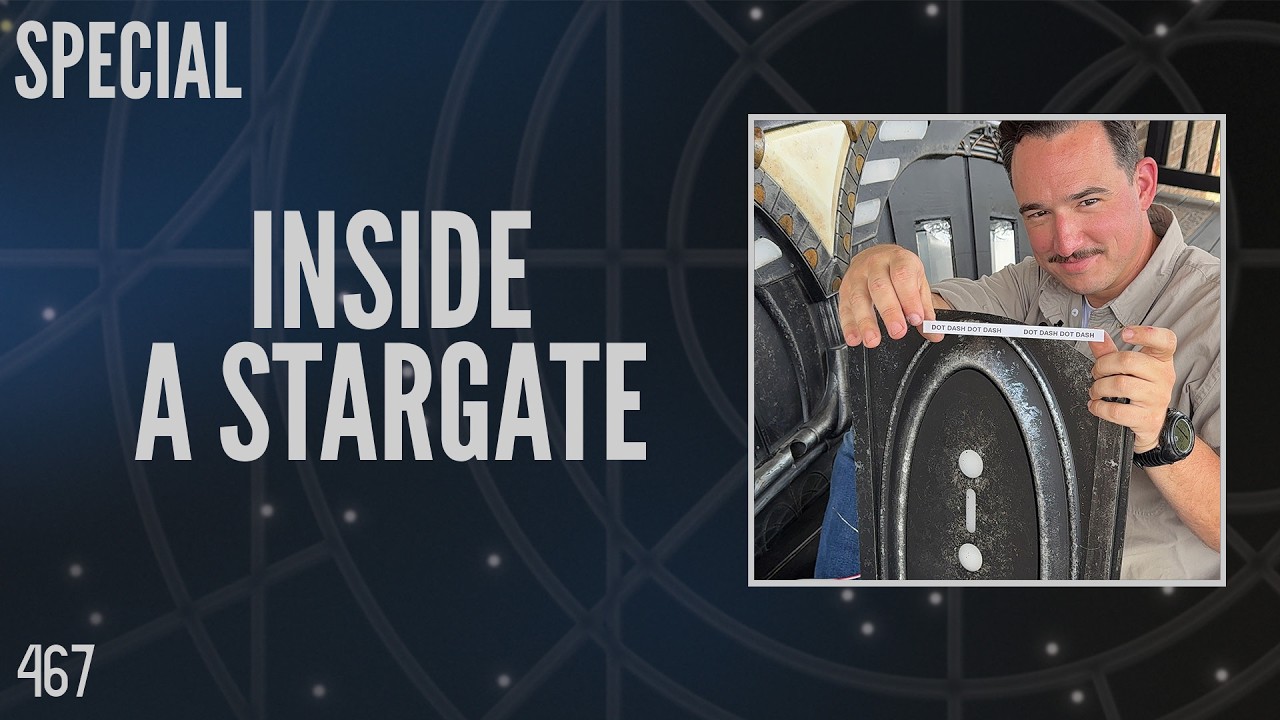
Inside a Stargate
Description
When Stargate Universe ended set construction separated each gate into parts to be sold at auction. Now, with the expertise of one fan, we will attempt to get this segment's chevron and glyphs lit again.
Share This Video ► https://youtu.be/wOTTojPWsw8 (opens in a new tab)
Visit Parker's Web site ► https://www.parkernash.com/ (opens in a new tab)
Visit DialtheGate ► https://www.dialthegate.com (opens in a new tab)
on Patreon ► https://www.patreon.com/dialthegate/ (opens in a new tab)
on Facebook ► https://www.facebook.com/dialthegate (opens in a new tab)
on Instagram ► https://instagram.com/dialthegateshow (opens in a new tab)
on Twitter ► https://twitter.com/dial_the_gate (opens in a new tab)
on Bluesky ► https://bsky.app/profile/dialthegate.bsky.social (opens in a new tab)
Visit Wormhole X-Tremists ► https://www.youtube.com/WormholeXTremists (opens in a new tab)
Visit The Daily Gate ► https://www.youtube.com/@thedailygate (opens in a new tab)
MERCHANDISE!
https://www.dialthegate.com/merch (opens in a new tab)
SUBSCRIBE!
https://youtube.com/dialthegate/ (opens in a new tab)
SUBSCRIBE!
https://youtube.com/dialthegate/ (opens in a new tab)
Timecodes
Coming Soon!
Transcript 8,007 words · Archived by Judith Remkes
David Read: Hey, everybody. David Read here, Sergeant Parker Brown. What’s your full designation?
Parker Brown: Lord Reverend Doctor Staff Sergeant Parker Brown.
David Read: SGU Gateroom Stargate segment. So, it has been my goal since I got this piece to get it re-electrified so that the glyphs and the chevron light, and this guy could supposedly do it. So, you’re not gonna see me for the rest of this. You’re gonna see him and hear me, and we decided to film this. Enjoy. All right, let’s go ahead. Ready?
Parker Brown: Ready.
David Read: It’s heavier than I remember.
Parker Brown: It’s about as heavy as I expected.
David Read: Exactly. It used to spin.
Parker Brown: A feat in itself.
David Read: Pip it. Pip it. [inaudible] So, what are you gonna do?
Parker Brown: Step zero is figuring out how to open it. There’s an amalgam of different screws on here from square to hex to shapes I can’t even identify, and I have no idea how this is put together. I am more than likely going to come at it from the sides where it’s bolted together. No, I can’t even do that because these are bolted from the inside. So, some inspection is required before I can determine how to get inside her.
David Read: All right. Let’s go ahead and get started.
Parker Brown: Let’s dig in.
David Read: What have I got over here for you? Come here. Hi. Hello. Yes. OK. There you go. So, SGU is your favorite series, right?
Parker Brown: I would say so.
David Read: Why?
Parker Brown: Absolutely no diss against SG-1.
David Read: Nope.
Parker Brown: It was so full and vibrant. SGU brought a darker tone that I really appreciate. There was an element of strife that you never had in the other series, and I really appreciate that interpersonal problem and that theme.
Parker Brown [clip]: Killing off Ginn and Dr. Perry this early, seriously, what are you guys thinking? I’m talking to the writers here, OK? What are you guys thinking? You should have given them a couple more episodes to really ingrain themselves as characters of meaning. What is wrong with you guys? Seriously. How dare you do that? I’m sorry. No, no, I’m not. No. How dare you do that?
David Read: Did the show have anything to do with you going into the Army?
Parker Brown: Yes and no. It was not my primary reason for joining. But once I joined, I did use that as an influence. I want to be as good as I can be so that if the Stargate program were real, they would want to evaluate me for participating in it.
David Read: There we go.
Parker Brown: And I know that sounds corny.
David Read: And you have the security clearance to know whether or not it was.
Parker Brown: Just about. I think as good a place to start as any are these back panels next to the chevron because these are completely free, and there’s obviously a light panel behind it.
David Read: Those Ancients, they love their hex keys.
Parker Brown: Square in this case.
David Read: OK. Oh wow, ok.
Parker Brown: So, we’ve got some pieces of plexi in here. They were at one time glued in, and I’m afraid to pry them out. But I can see in there now. It looks like off-the-shelf LED tape. And there’s a bolt hole here, but no bolt in it. So, I expect I would find the same thing behind this one. So, that’s not the avenue of approach I was hoping for. There is one large bolt here, but I don’t know if that’s structural, and I’m afraid to take it off right now. I may resort to that, but right now I wanna avoid that one. So, I’ve got the cover for this light panel back on. No access there. So, I’m gonna start with this back of the glyph panel. There’s a couple screws holding it in. It looks like it pivots out. We’ve got very small hex here instead of the square drive we had. And amazingly, it’s five-sixty-fourth, so I would’ve thought it’d been metric. Progress. I think we’re getting somewhere. These are all vacuformed out of Kydex. Let’s take a look inside. No way. This might be perfect. I have to get this off. This might be the easiest thing in the world. What I can see right here is power cables that they just cut.
David Read: Exactly. That’s what we were hoping for.
Parker Brown: Yes. I was afraid that they would’ve actually ripped out cabling.
David Read: There was no show after this one. There wasn’t any reason to repurpose.
Parker Brown: They labeled the aluminum. It says right end inner. It’s engraved right there on the tubing.
David Read: We’ll get James on the phone. You can show all this to him.
Parker Brown: So, right here, all they did was cut the cables.
David Read: Isn’t that sad?
Parker Brown: It is sad.
David Read: Necessary.
Parker Brown: It makes this a lot easier.
David Read: So, you just reattach.
Parker Brown: In theory, yes. I’m gonna be running some electrical tests before we ever plug it up to live voltage, but that makes this so much easier. The trick is gonna be getting back in here to figure out what I’m looking at.
David Read: Take off what you need.
Parker Brown: So, we’ve got six sets of cables here, and they feed up into this area. It’s zip-tied in place. And then if we can manage to get a good camera angle here with some light, we can see more cabling in the back there. A little blurry. There we go. That is going to the controller, and then those light gray cables go out to each of the glyphs. And this whole interior is lined with carbon fiber for a little bit of heat and also for structural integrity. Carbon fiber is very strong, and it is a very good insulator against heat. So, it does not transmit that heat. But then we have the back of these glyphs here. Focus. The back of the glyph panels, those are riveted together, so I’m gonna have to come at it from the front, but each of these aluminum plates is a heat sink for the glyph LEDs. I’ll have to dig in a little bit more and evaluate. It will not be as simple as connecting this to main’s wiring and then flipping it to on.
David Read: Right. Good to know.
Parker Brown: Round about 2002, 2003, SG-1 was well underway. Atlantis was very nearly coming out. And I had just moved to a new part of Indiana, didn’t really know anybody. I was young. And I ended up meeting a new friend through our church, a cousin of my pastor’s family. And he introduced me to Stargate. And if memory serves, I believe the very first episode I saw was Urgo. He had it recorded on a VHS that he had brought from home when he was visiting town.
David Read: Boring.
Parker Brown: Boring.
David Read: That’s how I wanna live. I wanna save the universe, and I wanna eat pie.
Parker Brown: And I was hooked immediately. I think we probably watched it three times through that weekend. I continued on watching it on my own time after he had left town. Went back and watched it from the get-go. Watched the feature film. And I was in love. And then Atlantis came along. And I wasn’t really into it at first, but it grew on me. And then Universe came along, and that was it for me.
David Read: So, getting to handle this stuff is cool.
Parker Brown: It is fantastic. I’m gonna have to think about SG-1 for a moment. I can tell you, my favorite episode of Atlantis is “Tao of Rodney.”
David Read: Okay. Tao.
Parker Brown: Tao. Tao?
David Read: Tao.
Parker Brown: Tao? OK. Universe, “Time.”
David Read: “Time.”
Parker Brown: I love a good time travel story.
David Read: There you go.
Parker Brown: And I suppose by proxy, can I give a two-parter for SG-1?
David Read: Of course.
Parker Brown: “Moebius.” Parts One and Two.
David Read: There you go. Wow. All good.
Parker Brown: All right. Well, I have a feeling this is not going to be quite as pleasant as we initially thought, but I believe it’s doable. There’s a thermal cutoff in here. The lights would shut off automatically if it got too hot.
David Read: I’m not surprised. Let me know when you wanna talk to James. We’ll dial him up.
Parker Brown: Sure. He designed this?
David Read: He… Not the electronics, but he designed the Stargate. It’s the production designer.
James C.D. Robbins [clip]: I’d done one design that I was happy with. I presented to Brad and Rob, and they both said, “Yeah, fine. We’re good.” I think I was probably gonna finish the drawing the next day and send it out, and I went to a restaurant with my family that night. It was one of those places where they give you the big sheets of paper they put down on the table, and crayons, a little bucket of crayons, and you can draw. So, my daughter’s five, and we were sitting there, and I’m drawing bunnies and raccoons with her. And all of a sudden, I’m drawing a chevron shape instead. So, I wound up coming up with the final design that is on the Stargate with a blue crayon in a restaurant. So, apparently the methodology really doesn’t matter. It’s the results that you’re really after.
Parker Brown: I think the next step is to remove the glyph panels on the front. Because this is all one unitary piece, and the thing I need is right behind this chevron. So, I think we’re moving to the front.
David Read: It’s kind of sad looking at it like this.
Parker Brown: In what way does it make you sad?
David Read: A, the magic is a little scarcer because it’s not meant to be seen this way. And B, it was pretty brutally cut up when they were done with it, but at least it was done to preserve it for fans rather than being chucked away. It could’ve been far worse.
Parker Brown: Let’s see what is behind lift number one. Is this someone’s blood?
David Read: No, it can’t be.
Parker Brown: Is this stage blood? This looks like stage blood.
David Read: I’m sure it is.
Parker Brown: When would they have gotten blood on the gate?
Rhona Mitra as Commander Kiva [clip]: They surprised us. Do you want me to explain it again?
Parker Brown: There we go. Very important note for later.
David Read: Far right side.
Parker Brown: The photograph.
David Read: I have so many photographs of it, not gonna be a problem.
Parker Brown: So, this will make my job easier, because these are simple LED strips. But then I’ve still gotta figure out how to get behind this. These are fairly standard for the time, off-the-shelf LED strips. They’re a hard circuit board with LEDs mounted on them, and you can split them to the desired length at these junctions. Everybody and their brother has LED tape on their bed frame and around their desk these days. This is what came before. We’ve got positive and negative coming in and a join. These should just be 12 volts. I can test for that later, but that should just be 12-volt LEDs, and very easy to drive. And they’re all pop riveted in place. This one’s come loose, but it’s little pop rivets in this aluminum enclosure with aluminum tape to cover up the edges and hide their crimes. This panel does not appear to come off.
David Read: Is that gonna be a problem?
Parker Brown: No, I don’t think so. I may have to reach in from the back and get out some things.
David Read: Be gentle with her.
Parker Brown: Of course. And it looks like actually these cable clamps that they’ve integrated here as dressing. Those are cable clamps with a little piece of tubing holding it in. You can see the screw on this one. There might be a screw hiding underneath this tubing. I’m sorry, I’m out of frame there. These cable clamps might have a little screw. There it is. There’s a screw underneath there, and I can see a hint of an access hole behind here. There we go. Trying to keep everything in frame. That might be our avenue in, because they’re pretty evenly spaced with the glyphs. There’s absolutely a hole here. That might be something. I would love to pick the brains of anybody who assembled this the first time. I wanna hear them talk about it, everything they loved about it, everything they hated about it, why they made certain decisions, why they didn’t future-proof certain items. ‘Cause maybe this is the engineer in me, but if I was designing something like this and I was maybe not guaranteed but expecting it to be lasting for multiple years, I would’ve built in a way to service certain aspects of it without all this, hidden panels that come off cleanly. Certainly no insult to them for doing it the way they did. It comes across beautifully. It is stellar, pardon the pun. But I would like to know why they made some of the decisions they did. Ah, yes. Each of these are hiding a bolt that will let this face come off.
David Read: And we need the face to come off?
Parker Brown: It would certainly make things a lot easier.
David Read: There we go. In for a penny, in for a pound.
Parker Brown: All right. That’s what we were missing. Progress. There we go.
David Read: It’s his middle name.
Parker Brown: Progress is his middle name. They didn’t even use real cable clamps for this. They formed their own out of Kydex. These are all custom made.
David Read: So, they’d sit better? You know what’s gonna happen from this?
Parker Brown: What?
David Read: Everyone and their mother who has one of these is going to reach out to me to have you flown in.
Parker Brown: Oh, my God. There’s only seven of them.
David Read: There’s nine.
Parker Brown: Duh.
David Read: And then there’s another seven for the location gate, but I don’t think that those have LEDs, ’cause that one didn’t… That one was digitally lit. It may not be, though. It may have actual LEDs in them, so…
Parker Brown: I would be surprised if it was not lit. So, at some point, somebody was putting way too much torque on this or trying to use the wrong size, because they have–
David Read: Stripped it.
Parker Brown: Not quite, but it’s dented. They’ve almost turned it into a 12-point. They probably had the next size down of Imperial and had to make do with that. I’m guilty of it. I will feel less bad about using mismatched screws on my own builds in the future with the variation of screws they used for these.
David Read: Man.
Parker Brown: So, this whole bottom segment is free now, and it’s being held in at the top. Note to self, the ones on top are shorter than the ones on bottom. Of course. Lo and behold, the same four-millimeter bolt. So, they’ve had strips of adhesive on the back.
David Read: Probably wearing out.
Parker Brown: I’m wondering if some of these were never peeled on one side, because this one was actually stuck on. This, I don’t see any residue on the gate, and it’s perfectly smooth here. I don’t think they ever peeled off the other side of the tape to stick it on.
David Read: Just an accident? They were moving so fast they forgot?
Parker Brown: Or they decided it wasn’t necessary.
David Read: So, they attached it and never went ahead to stick it. All I know is that was Boeing, so it might have been a good job to — good idea if they hadn’t.
Parker Brown: Anybody who has worked on mechanical things will know if the right size of hex is not working ’cause it’s been stripped out, the next size up of torques will fit.
David Read: It’s ready to pop.
Parker Brown: No! Come look at this. Come look at what is sitting right on top. Who lost their screwdriver bit?
David Read: Wow. Look at that. Holy crap. I was never positive that I had one from the gate room.
Parker Brown: I think that there’s no doubt now.
David Read: Wow. Oh my God.
Parker Brown: I’m gonna take this over that side.
David Read: It says chevron… I have chevron seven.
Parker Brown: Wow. Can we get Gary on the phone while I screw it together? To say chevron seven is locked.
David Read: Chevron seven is locked. Wow, looky there. So, we’ve got some cabling here. These all tie in to our accent lights and the glyphs. These were connected straight to the controller. This one is by itself for some reason. I will have to undo zip ties. I will replace them. I have plenty. I will have to undo zip ties and trace these to figure out what’s what.
David Read: You ready to meet James? He’s available now.
Parker Brown: Please.
David Read: Good morning.
James C.D. Rollins: Morning. How are you, David?
David Read: I’m very well. I have something very interesting to show you.
James C.D. Rollins: You were saying. Some LEDs… Oh my goodness. Wow.
Parker Brown: There we go.
David Read: So, someone actually left their screwdriver in the casing.
James C.D. Rollins: I’ve been looking for that.
David Read: That’s funny. But I didn’t expect to see the wheels and everything still in there. So, popping that open was actually really kinda cool.
James C.D. Rollins: So, where did you acquire this?
David Read: So, this was originally the auction. I forgot the company that did it, but they sold all of the Stargate Universe stuff after Propworx sold SG-1 and SGA. It went to Paul and Michelle, a couple of friends of mine, and they got two of them and gave me one. Look at the teeth here. So, I’m guessing this is all–
James C.D. Rollins: That’s all part of the whole mechanism rolling on the floor.
David Read: Wow.
James C.D. Rollins: I would believe.
David Read: Just extraordinary.
James C.D. Rollins: And to this day, I’m still astounded at what they’re able to do. I worked on other shows and had some other big builds and stuff, but the stuff we did on a day-to-day basis was unbelievable.
David Read: We’re lighting it again. When the Atlantis gates were given to Propworx, Mark and Robert Davidson rewired them so that they would be lit. But the Universe gates, for whatever reason, I guess they were moving through them more quickly, and they elected to put the end caps on them but not re-electrify them. So, unlike Atlantis, the LEDs were kept–
James C.D. Rollins: The reason behind that though, David, is because Mark was still on the show for the other two incarnations. Universe was the end of the world, so not many of us went back.
David Read: Exactly.
James C.D. Rollins: So, they tear it down, you get it in that shape.
David Read: Exactly. It’s wild to see it exposed like this. So, all the grease and the moving parts. Look at that. My God, it spins. So, a bit greasy. Nice and greasy. It don’t spin no more, James.
James C.D. Rollins: Ah, that’s true.
David Read: But we wanted to share this moment with you.
James C.D. Rollins: I appreciate it.
David Read: Looks like space shuttle heat shielding.
Parker Brown: Ethernet cable.
David Read: Yes. It ran to a PalmPilot. It spun on a PalmPilot.
Parker Brown: That makes so much more sense. Because it’s not connected to the lighting. It would’ve been connected to the drive system, which is not included in this section.
David Read: I suspect that that’s in chevron 9.
Parker Brown: I think it was in this section and they removed it. Because otherwise, why would it terminate here?
David Read: I don’t know.
Parker Brown: This one is not for lighting. It was a sensor so that it knew when to stop. Because they’ve got capacitors in here for smoothing, because the signal in the electronics would’ve been juttery as it spun. They put inline capacitors to smooth it out to a normal sine wave.
David Read: So, what are we gonna do now?
Parker Brown: Right now I am gonna do a diode check, and that will tell me if they’re still functional. So, I’ve got a function on my meter. It should tell me if everything is OK when I probe these wires. That’s not promising right up front, but that may change later on. For this kind of application, I would expect it to be either 12 or 24 volts.
David Read: I’m a little disappointed that that did not yield anything when you plugged it into the–
Parker Brown: Don’t be too disappointed by that. It might not mean anything. There might just be one tiny component that has failed and is nullifying my test. However, because they used those LED strips, much like the LED tape we use nowadays, replacing it would be trivial. But now I need to know what they put behind the main chevron.
David Read: So, we’re gonna have to pop it off.
Parker Brown: We have to pop that off. This part does come off. And I’m gonna assume that behind here is more LED tape, like on the glyphs. I would think, because it’s that small. Ow.
David Read: What happened?
Parker Brown: Stabbed myself with a screwdriver.
David Read: Don’t do that. That’s not nice.
Parker Brown: What did I say? Look at that. It’s a mere Deathly Hallows of LED tape.
David Read: Wow. OK, then.
Parker Brown: This could be really good or really disappointing.
David Read: Let’s find out.
Parker Brown: I don’t know why I’m so nervous right now.
David Read: Because this is the moment. It’s fine.
Parker Brown: Damn. So, it’s dead. They might not all be dead.
David Read: OK. His weren’t, which is what I don’t understand.
Parker Brown: Hey. You’re gonna have to get closer to see this. OK. That light is dead. That light is dead. They are dead. There’s three of them on that board that are dead. But what they did, they doubled them up because these are natively 12 volt, and they doubled them up to make it 24 volt. That’s why my meter wasn’t registering, because it specifically checks for diodes, and if three of them are dead, that might throw it off. You have a decision to make, David. I think I can reconfigure this back to 12 volts. And it will run off of the power supply that I brought with me. Is that acceptable to you?
David Read: Yeah.
Parker Brown: Outstanding.
David Read: What about the glyphs?
Parker Brown: I can do the glyphs, too.
David Read: I’m curious to see if they’re in a similar condition.
Parker Brown: They are. They had the same red, green, and black wiring. They have four. They have positive coming into one strip. They have a jumper from negative of that one to the positive of the other, and then negative coming out of that. So instead of two strips being powered in parallel by 12 volts, they’ve got them in series to require 24, which I’m sure was a limitation of their power supply at the time. That makes perfect sense. But it’s trivial to make this 12 volts now because it’s already there. I have to change the wiring.
David Read: So, we were gonna electrify this side as well, but this whole panel would have to come off, so we’re gonna leave this one for the time being, and maybe leave that for a future date.
Parker Brown: Further to that, because of the way this is built, that front section had to come off to access the spinning mechanism. I don’t know how this is gonna attach. It may have the same bolts, but it fits so much more flush. Excuse me. It fits so much more flush than the front part did, where it had that gap. I really don’t wanna mess with it. And I definitely do not wanna try to come in through this side to work on it. It appears to attach in the same way, but it is more trouble than it’s worth at this time. So, we’re gonna stick with lighting up the front section with the chevron and the glyphs. So, my main objective right now is to trace out all of these paths for the existing wire, duplicate it out of this doorbell wire. I’m not gonna remove anything that’s already here. It’s gonna be unused. It is being replaced, but not removed. That’s the goal. I’m gonna start off with the main chevron. David has asked that I share some of my military background as I work, being that Stargate is primarily an American military show. Stargate was not the primary reason that I joined the military. I got out of high school and I wasn’t certain what I wanted to do. I took some time off. We sat down for dinner one night and it was on a Monday. My dad says, “If you join the National Guard, they’ll pay for your college.” I said, “I know, Dad, I’m not really looking to join the military right now.” “OK. All right.” Went on with our lives. Next day on Tuesday, sat down for dinner. My dad said, “If you join the National Guard, they’ll pay for your college.” I said, “I know, Dad. It’s just military doesn’t really seem like my thing.” “OK. OK.” Same thing on Wednesday, Thursday, Friday, and then into Saturday. And he started in again on that Saturday. Said, “If you join the military, they’ll pay for your college.” And I slammed my hands on the table and I said, “Fine, I will talk to a recruiter.” A few weeks after that, I had taken the ASVAB, the military aptitude test, and begun the process to enlist in the Army National Guard. I joined as a 13 Juliet, which is a field artillery advanced tactical data systems specialist. Very fancy way of saying that I use maps and protractors and computers and a slide rule to do fancy math in order to calculate the flight path of cannons and rockets so that they hit the intended targets. This is why David is so prone to saying that I am a rocket scientist. In the truest sense, I am. I do not engineer the rockets. I do not work on their systems, but I do do the math for how they fly and where they land, or rather impact. I spent about 13 years of my career with a cannon unit in Kentucky. I have served two tours overseas, the first to the Horn of Africa and the second to the Middle East. And I did a whole tour of the Middle East where I set boots on ground in Jordan, and the United Arab Emirates, and Syria, and Iraq, and Saudi Arabia, and a handful of other countries that I can’t even remember the names of at the moment. It was in Syria that I was injured through an unfortunate series of events, not inflicted during combat. My left arm was injured, and I was flown out of Syria by way of helicopter to Iraq, and then a plane ride to Germany, where I had two titanium screws installed into my arm. And as a result, my left arm no longer goes straight, and I’ve got a lovely scar here where they had to install the screws. Two titanium cannular variable-pitched screws. And funny enough, in my civilian career later on, one of my clients happened to be the company which probably made those screws. It’s hard to tell now because I don’t exactly know the serial numbers of the screws. And after that injury and being less than perfectly fit for service overseas or in the field, I accepted an offer to become an instructor, and I now teach what I used to do. So, I teach advanced mathematics for a regional training institute for the Kentucky Army National Guard. And I love my job. I think it is one of the coolest things in the world. I am very pleased with the outcome of my career. I would love to have a fully functional arm, but such is life. And when David comes back, I will give him the opportunity to ask me any specific questions that he may want me to enlighten you on. Speak of the devil, and he shall appear.
David Read: Be careful.
Parker Brown: I had wrapped up summarizing my service history.
David Read: Wow. OK then.
Parker Brown: I didn’t know if you wanted to ask any specific questions for me to share.
David Read: It only depends on how much you’re willing to talk about.
Parker Brown: I will tell you anything that is not classified.
David Read: You have had to eliminate enemy combatants directly.
Parker Brown: This is correct.
David Read: There are not many people that you can ask, what is it like to have someone else’s life in your hands and to take them from this world. But I’m not gonna ask you that question. What’s more interesting to me is, do you view Stargate in any way differently after having had an experience like that?
Parker Brown: That’s an interesting question. I think that requires a moment’s consideration.
David Read: Please consider. You run, simulate, keep me posted. Keep me apprized. Don’t burn your fingers off. How goes it, by the way?
Parker Brown: So far so good. So, I’ve got this wire here that’s coming up to the main chevron, and then I’m gonna daisy chain all of these. Rather than split off into a tree, I’m gonna go from the end of one into another, which is exactly what LED tape like this is for. It’s like an endless link.
David Read: Keeps going and going.
Parker Brown: Keeps going and going.
David Read: Can you tell us the day that you had to fire on the enemy?
Parker Brown: Yes. I will tell you a fair portion of the story. I was working in the operations center on second shift one night by myself, rather than a team of three.
David Read: How far are you away from the mission site?
Parker Brown: Actually, that would be classified because that would give away the range of our munitions.
David Read: But you were not overseas operating a drone.
Parker Brown: I was overseas watching through a drone. I was not operating said drone. We leave that to the Air Force. Thank you, Air Force people. I have utilized your assets many times. My commander came into the TOC, Tactical Operations Center.
David Read: What year is this?
Parker Brown: This was in 2024. And he was in civilian attire at the time, which was uncommon, especially given the hour. It’s nearly 10:00 PM at this point. And he rushes through the operations center. I barely had enough time to greet him. “Good evening, sir. How are you?” All that. He gives a vague response to the greeting and rushes into his office. A couple of minutes later, comes back out with a Post-It note and map coordinates written on it, and he hands me this note and he says, “I need you to see if we can range this from insert site here.” And then he rushes away. So, I plug those coordinates into our system, and I pull up some satellite imagery and some drone footage and some other intelligence assets that were at my disposal. I do some of the rocket science that I’m known for, and I determine that it is a viable target. We can range it, and I’ve determined what is at that site. So, I finish that up, and I knock on his office door. He allows me in, and I said, “Sir, I’m done if you’d like to come take a look.” And he said, “What do you mean you’re done? It was a yes or no question. Can we range it?” And I said, “Sir, I’ve got some more information you might wanna know.” So, he comes out and looks. I explain to him everything I went through, and he starts laughing. And he says, “Come into my office. I wanna show you something. Oh, by the way, I’m granting you top secret clearance for this.” And he hands me a stack of papers about a quarter-inch thick. And he says, “Everything you did in 15 minutes took the Pentagon three weeks.”
David Read: Pentagon’s lost entire countries.
Parker Brown: And he was so impressed with my work. I am actually quite proud of this part, so I will boast. He was so proud of my work that we transmitted my mission plan up to the Pentagon, got their approval, overrode what they had planned, and went with my mission plan instead. So, colonels and generals and whoever else who came up with that plan were put in their place by little old me. And a few days after that, there were fewer people on the planet and some much larger holes in the ground.
David Read: Were these people gonna hurt other people?
Parker Brown: Absolutely. They had already caused a significant loss of life and limb to American personnel, and my actions prevented any further from happening. I think to answer your question, no, I did not view Stargate differently after my experiences overseas. I had already had some experience in theater much earlier in my career. My first deployment was mere months out of training. I showed up to my unit and they said, “Welcome. We’re glad to have you. Sit down, watch these briefings. We’re leaving in three months.” I was one of two people that was the last to come to that unit before we left the country. So, I’d already gotten a taste of it by then. And in my line of work, it is exceedingly rare to actually perform the duties for which I am trained for real. Artillery is not used nearly as much as it used to be. So, I count myself fortunate that I was allowed to fulfill my purpose.
David Read: Does your job mean more to you now that you’ve had a kid of your own? Does the duty and obligation feel the same? Knowing that he may watch this one day.
Parker Brown: My son was born after my first tour of duty. I have been a member of the military his entire life. He’s never known any different. I think it did shift my perception a bit after he was born. There are many service members who, when their children grow up, they may encourage them to enlist or be proud if they choose to enlist of their own volition. I do not wish that of my son.
David Read: Is it his temperament or what?
Parker Brown: No, because I don’t want him to have done the things which I have done in my career.
David Read: Why?
Parker Brown: There may be certain aspects of my military career which I am not entirely proud of, and there are certainly physical and psychological effects as a result of my service. I have aches and pains that seventy-year-olds should know. And there are nights where sleep and I do not necessarily come to terms. I’ve lost a great number of people to various situations from events in country or suicide after the fact. And I would not wish that on my son. I would like to spare him from the grief and the sorrow and the literal pain that can come from signing over a blank check to one’s country and offering years of service in its defense.
David Read: Do you not think that he deserves the opportunity to do that for his child?
Parker Brown: That is a completely fair question.
David Read: It’s OK to not have the answer to it.
Parker Brown: I don’t believe I do. But it is a good question.
David Read: If you could have taken a different path, would you have?
Parker Brown: Everybody would make small changes, but I think I would have done more or less the same thing.
David Read: I think then you might have the answer to your larger question as well. It might not be as easy to swallow. But I appreciate you being so candid.
Parker Brown: I have a general policy in my life. I would rather be told an uncomfortable truth than a sweetened lie. I would much rather people do the same thing for me and be honest, even if I don’t like what’s coming.
David Read: Don’t we watch SG-1, the unit doing the exact same thing with each other rather than absconding with information?
Parker Brown: We absolutely do.
David Read: Don’t we see them leading with truth and with resolve in order to serve a greater end?
Parker Brown: We do.
David Read: “General Hammond, I have spent many years in the service of my country, and I have been ordered to do some damn distasteful things.” That’s Tom Astle’s “Cor-ai” and very much the original idea of it really in effect.
Parker Brown: Whoever wrote that line–
David Read: Tom Astle.
Parker Brown: I see. Was he in uniform ever?
David Read: No. But a very perceptive writer.
Parker Brown: Incredibly, because he hit the nail on the head.
David Read: Hey!
Parker Brown: Hey. OK, so we do have one, two, three, four, five, six, seven…
David Read: It’s fine
Parker Brown: … seven LEDs that are dead. In the grand scheme of things, you’re not gonna notice.
David Read: Now, these are the original LEDs?
Parker Brown: These are the original LEDs.
David Read: So, I can leave this thing on…
Parker Brown: Yes
David Read: … knowing that you have the ability to come in and install some new ones at some point.
Parker Brown: Absolutely.
David Read: If need be.
Parker Brown: Absolutely. That is the chevron…
David Read: There we go
Parker Brown: … wired.
David Read: Speaking of Stargate, strictly speaking, is this your favorite gate?
Parker Brown: Ooh, that’s tough. I’m gonna say no, I prefer the Milky Way gate. I love the mechanics of Destiny’s gate. The whole thing spins…
David Read: I love it
Parker Brown: … and the aesthetic of it, the clean white lights. But something in my brain triggers when I hear the sounds.
David Read: The ridges you said? The snaps of the chevron?
Parker Brown: I don’t even know how to describe the sound. The “waa” when it starts up.
David Read: When it starts going in the other–
Parker Brown: I love that sound.
David Read: Dun, dun.
Parker Brown: All right. And there are two LED strips in each of the glyph panels. I am removing the original wiring and replacing it with my wiring in the proper configuration. But I wanna label each of these original wires so they’re properly cataloged, including the tiny little jumper that was between them. I am going to include this. I’m gonna tape it to the wire bundle so that it is not lost. And I know that may seem strange to folks, that I’m keeping this tiny piece of wire, but this is archival. David told me I did not need to, but I asked him if he wanted to keep the zip ties, the original zip ties that I cut out. He said, “No, they’re zip ties. I get it.” He may feel the same about the wire, but I am going to leave the wire in here. I’m going to keep that. I have these two glyphs and those accent lights tied into the same circuit. My next step is to do the same thing on this side, and then both of those legs will tie in with the chevron, and I’ll have a single point of power. This is gonna get tucked in. There’s a framework on the main body that I’ll show you in a moment. That’s gonna get tucked into there. I’m gonna zip tie it down, and that should allow the cable to come out without having to cut any holes or drill any openings or anything like that. So, we now have full lights, and you’ll be seeing it shortly once we get it all mounted up. It’s working?
David Read: Very, very nice.
Parker Brown: My God. It’s beautiful.
David Read: It is beautiful. Nice.
Parker Brown: I might cry.
David Read: Well done.
Parker Brown: It’s so beautiful.
David Read: Are you proud?
Parker Brown: I am. I am both proud and humbled at the same time, as oxymoronic as it is.
David Read: So, Parker, I have you officially labeled as gate repairman.
Parker Brown: Very good.
David Read: You did it. I never doubted your competence, but there was an issue of whether or not it was gonna be broken.
Parker Brown: Absolutely. I share the sentiment.
David Read: The reason that we’re doing this now is because you had to take off. You had to get back home. I had been doing a show part of the time that you were repairing this. I was actually doing an episode of Wormhole Extremists. So, we didn’t really get to decompress afterwards. So, we’re gonna spend a few minutes doing that now. You’ve had about six days since you put your hands on this thing and brought it back to life. Thoughts?
Parker Brown: Far and away one of the most interesting things I’ve done as of late. Definitely, I think I said it originally and I’ll say it again, I would love to talk to the people who originally built the thing because that is an impressive piece of work. The fact that it even did what it was supposed to do just baffles me. I’m very pleased with how it came out.
David Read: I did get you in touch with James. I’m so thrilled that we got to have him a part of this. I’m very pleased. Was it more complicated than you expected or was it on par about with what you thought it could potentially be?
Parker Brown: It was complicated in a different way than I was expecting. The actual wiring of it was way simpler than I thought it would be, but getting into the thing was unexpectedly complex. I was not expecting 38 different screws just to get at a few different areas of the gate. So, some more complicated, some less complicated. I’m very, very glad that the wiring ended up as simple as it did. It’s just LEDs. Just LEDs.
David Read: Any other Stargates in your future that you’re gonna be repairing?
Parker Brown: Not to my knowledge. But just in case, not you, David, but anybody watching this: if you are one of the people who owns one of the other segments and you would like it restored, get in touch.
David Read: He’s the guy.
Parker Brown: I’ll see what I can do for you.
David Read: Go ahead and reach out to me. If people wanna get in touch with you directly, is there anything that we can provide them? Where are you available?
Parker Brown: It’s adjacent, but the easiest way to get in touch with me would be my website, parkernash.com, and you can send me a contact email there and I’ll reach back out. That’s technically for voice acting, but it’s the easiest way you’re gonna find me.
David Read: We didn’t talk about that at all. Do you wanna…
Parker Brown: You’re correct. We did not.
David Read: … give me your elevator pitch? Where did this come from? And why now?
Parker Brown: I grew up at that golden era of cinema where people like Robin Williams were making waves, and I was just that kid doing voices and telling jokes. And I always thought, “Being a voice actor would be pretty cool, but how am I gonna get into that? I have to know people, I have to network, I have to connect,” blah, blah, blah. And now we live in this wonderful age where anybody can do anything with the power of the internet. And I met somebody at Dragon Con this year, told them about my aspirations to be a voice actor. And they said, “What’s stopping you?” And no one had ever asked me that before. It was usually, “That sounds cool,” or, “You’d be really good at that.” No one ever asked what was stopping me.
David Read: Did you say, “I need an agent?”
Parker Brown: Not exactly. I listed a few concerns and they were like, “You can do all that on your own. You can use AI tools to help you build a site. You can put yourself out there. There’s websites for this kind of thing.” And they wouldn’t take no for an answer.
David Read: Wow.
Parker Brown: Here I am, two weeks into it. I’ve got a couple small gigs booked already.
David Read: Wow.
Parker Brown: And we’ll see where it goes from here.
David Read: Congratulations.
Parker Brown: Thank you.
David Read: That’s awesome. All right. Very good. All of us watching will remember, we were here with you, and then we watched you climb all over us to get to where you went. So, this is good stuff.
Parker Brown: I hope to not climb over you.
David Read: Geez, man. I am thrilled to have you in my life now. I am really thankful for this friendship and looking forward to whatever happens to you next. And don’t be a stranger on the channel, OK?
Parker Brown: Absolutely. And the same for you. You got my number. Give me a call anytime.
Parker Brown [clip]: Eli’s dark side. Get revenge, my man. All right, and obviously we’re going in chronological order here because if you’ve seen the episode, and I surely hope you have because I don’t like giving away spoilers, then you know that Eli does not get his revenge. But I fully support Eli’s decision to don camo and a vest and a gun, at least one, and various armaments, and go after Simeon and kick his butt. I support that one hundred percent. I think you have more reason to than Rush ever did, even though Rush can be egotistical. It’s one of his many flaws, but they seem to all work out in the end. Anyway, Eli, I sincerely wish that you had gotten your revenge, and David Blue, on the off chance that you watch this, I was rooting for you. I really was, and I’m sorry you didn’t get to wring Simeon’s neck. Simeon, by the way, I hate his guts. I thank the Lord he is dead.